

We’ve already noted today that the ‘AEMO releases 2026 ESOO on Tuesday 25th August 2026’:
- That article was deliberately constrained to just noting the release of the ESOO, and pointing to news media articles
- With any analysis and commentary saved for later articles.
The analysis and commentary we begin with this article … and readers should be clear that, with this one:
- does not speak to the detail of the modelling performed;
- but rather in terms of the higher-level context in which the modelling was framed, and results presented.
Earlier comments from us
Worth briefly touching back on some earlier comments from us…
In 2021 …
Again worth reminding readers that it was over 5 years ago that we posed the question ‘Observation 8/22 from GenInsights21–what is the purpose of the ESOO (Electricity Statement of Opportunities)?’ (via GenInsights21 ).
What follows has been (in my view) stemming from some overlapping (and conflicting) purposes ascribed to the ESOO … which seems increasingly less a genuine ‘Statement of (Commercial) Opportunities’.
In 2024 …
In reviewing the 2024 ESOO two years ago in the article ‘Once through the ESOO (for 2024)’, we highlighted a ‘Switch-a-roo with the Scenarios’ … noting a too-subtle but very important change from the 2023 ESOO forwards, which we felt:
-
- was important to understand, and acknowledge
- but which was too frequently overlooked.
We’d recommend you re-read there, before proceeding further. A bit like the magician’s sleight-of-hand trick, the AEMO has continued this approach through the 2025 ESOO and now into the 2026 ESOO, and I fear that many may have missed the magician’s genius!
In 2025 …
At the NEMdev 2025 conference, and afterwards in the article ‘Some suggestions for the Nelson Review panel to consider (with respect to Forecasting) following review of the Draft Report’, I also spoke about the switch-a-roo.
I wrote:
‘Readers on WattClarity would not have been surprised (if in the audience at NEMdev 2025) to see these drawn together using this LinkedIn update by Daniel Westerman that was posted on the day of the release of the 2025 ESOO.

In 2026 …
On 25th July 2026 we shared this ‘An interim ‘Conference Wrap’ (Part 2) from 2026 winter Conference Season’.
1) this article contained 14 discrete observations from winter conference season to that point
2) particularly relevant here was ‘Observation #3) What a Grand CIS-appointment!’
Following from that and in anticipation of this week’s release of the ESOO, last week Dan wrote:
1) Firstly ‘Revisiting the CIS-awarded project pipeline, ahead of the ESOO 2026’;
2) and then ‘How the CIS differs from state-based underwriting schemes, and what the industry has suggested about it so far’.
Framing the 2026 ESOO results via the older (i.e. firmer) lens from 2022 and years beforehand
Let’s start by re-framing the presentation of the results in the 2026 ESOO in the way they would have been framed in versions of the ESOO up until the change was made in 2023 …
| Frame of reference | Results, presented in the 2026 ESOO | A brief discussion |
|---|---|---|
|
What used to be called the ‘Base Case’ Scenario … containing only Existing and Committed projects . |
Sadly, a reader needs to flip through to page 84 of the 2026 ESOO to arrive at the equivalent of what used to be the most important artefact in ESOOs until the switch-a-roo was implemented. Here we find both:
For those who want a better view, click on the image here:
|
Take a particular look at the modelled unserved energy for FY 2029-30:
This is the year that would take account of:
… with only fully ‘Committed’ plant to replace it. Every reader should understand that this is a pretty sobering view. |
|
First order sensitivity Let’s call this ‘Rose Coloured Glasses’ view |
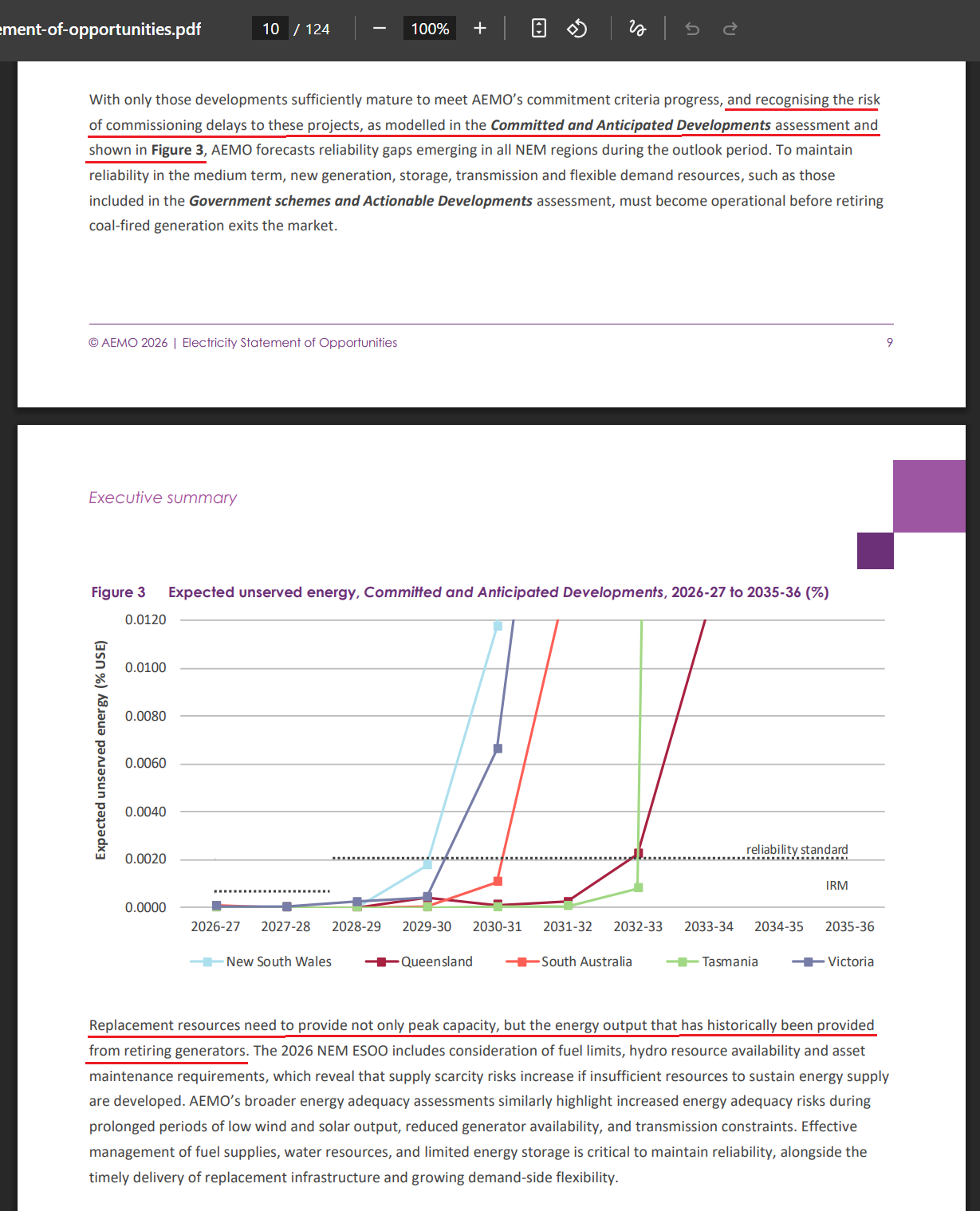
As a first step away from this ‘Base Case’ modelling, AEMO then assumes a greater number of replacement projects will proceed in what (I believe) should be framed as a first order sensitivity. Rather than burying this one at the back of the ESOO, this one is given quite some stature, as Figure 3 on page 10 of 124:
|
This scenario builds from the scenario-formerly-known-as the Base Case above and adds in a range of projects that:
The AEMO calls these projects ‘Anticipated’. Let’s pause to understand what this category consists of.
… Dan explained our understanding at that time, that: ‘Anticipated – Projects that meet at least three of the five criteria. If the developer does not submit survey information back to the AEMO at least once every 6 months, the project is bumped back to ‘publicly announced’ or withdrawn from the database.’ … and in his article last Tuesday noted: ‘Anticipated projects meet at least three of the five (and are obliged to have submitted a survey update to the AEMO in the previous six months).’ In other words, a project might meet only 3 of 5 criteria and still be classed as ‘Anticipated’. Remember that the five criteria are:
… that means that a project that has land and contracts (e.g. for the equipment) and planning approvals (e.g. a DA, transmission connection and so on) would, I believe, classify as Anticipated:
There’s also been some discussion that a gong from a CIS round might be enough to tick the ‘Finance’ box (can’t recall where I read/heard that). If that is true, then this truly would be a shaky metric on which to base a ‘rose coloured glasses’ scenario. On page 8/124 the AEMO makes specific mention of the following projects included in this scenario were: ‘Specific projects included in this assessment for RRO purposes were: • Kurri Kurri Power Station (750 MW open cycle gas turbine [OCGT]) in New South Wales from September 2026, • Snowy 2.0 (2.2 GW/350 GWh) in New South Wales from December 2028, • various utility-scale battery developments (18.9 GW /50.6 GWh) across the NEM, • a total of 6.8 GW of wind and 9.1 GW of utility-scale solar generation developments, and • transmission projects including Project EnergyConnect, HumeLink, Central-West Orana Renewable Energy Zone (REZ) Network Infrastructure Project, Hunter-Central Coast REZ Network Infrastructure project, Western Renewables Link, Gladstone Project, Project Marinus Stage 1, and New England REZ Network Infrastructure Project.’ I’ll just leave this here, because readers will be able to form their own view of how rosy indeed is this rose coloured glass scenario. But worth noting the coincidental article from Robert Gottliebsen in the Oz today titled ‘Fate of $12bn Snowy 2.0 hangs in balance as new drill tackles impassable rock’. Now Robert (and most of the News Corp stable) are not fans of net Zero and the energy transition … but what he writes about (if true) does speak to these concerns. |
|
Second order sensitivity Is there any other realistic way to describe this than the ‘Fantasy Land’ scenario. |
Given that it’s so ‘off with the fairies’ as a scenario that (a growing number realise) has very, very low chance of being delivered, it boggles the mind that this work of fiction is presented as Figure 2 on page 9 of 124:
… and yet (sadly) many will not read past the seemingly reassuring chart and mild caveat. |
Stepping further into Fantasy Land (compared with the list of projects considered in this scenario above) we consider what’s included. Usefully, the AEMO lists them at p8 / 124 ‘The government-supported or actionable developments included in this assessment were: • the Federal CIS (currently awarded projects, and RETA targets totalling 18.4 GW of generation or storage capacity only), • the New South Wales Electricity Infrastructure Roadmap, and its firming tenders, • a total of 11.5 GW/50.5 GWh of additional government-supported new storage developments across the NEM, • a total of 14.4 GW of additional government-supported new wind developments, • a total of 5.0 GW of additional government-supported new utility-scale solar developments, • transmission projects identified in the 2026 ISP as actionable projects, including Victoria – New South Wales Interconnector West (VNI West), Sydney Ring North, Sydney Ring South, and Project Marinus Stage 2, and • a total of 5.0 GW of new projected coordination of CER (largely behind-the-meter battery systems) – more than nine times the current level of coordinated CER – alongside 0.7 GW of new flexible demand response capacity’ I can only think that Darryl Kerrigan would be saying ‘tell them they’re dreaming’ in relation to a number of projects written into that list.
|


I get that there is a desire to avoid the headlines of ‘blackouts’ (which Dan’s article here in August 2024 documents as almost a ‘rite of passage’ on the publications of the ESOO in years gone by).
But my sense is that a far more important perspective is that the purpose of AEMO forecasts is (or at least used to be) to elicit a market response, no matter the time horizon … no matter whether:
- Short term (P5 and P30 predispatch, PD and ST PASA)
- Medium term (via MT PASA)
- Long term (in the ESOO and the ISP).
Starting off the ESOO by giving most highest ranking to the Fantasy Land Scenario surely can’t be helpful in doing this?
… or what am I missing?
The evolving switch-a-roo, through 6 editions to 2026
With the above in mind, let’s work backwards through 6 editions of the ESOO to see if we can understand how we’ve ended up so far from where we used to be …
| ESOO Year | The true ‘Base Case’ Scenario,
i.e. only Existing and Committed |
A first order Sensitivity Scenario,
i.e. Rose Coloured Glasses |
A second order Sensitivity Scenario,
which in 2026 is Fantasy Land |
|---|---|---|---|
|
2026 ESOO
|
Essentially buried on p84/124 as Figure 40 How many readers will get that far into the report? Unlikely any media will. |
Presented on p10/124 as Figure 3
|
Presented on p9/124 as Figure 2
|
|
2025 ESOO |
I’ve not yet had a chance to re-review the 2025 ESOO to see where this one was buried in that year. |
I’ve not yet re-reviewed the 2025 ESOO but suspect the pattern was the same as in 2024 and 2026. |
I’ve not yet re-reviewed the 2025 ESOO but suspect the pattern was the same as in 2024 and 2026. |
|
2024 ESOO
|
Per our article of August 2024, I did not even find/include this?
|
Per our article of August 2024:
|
Per our article of August 2024:
|
|
2023 ESOO
|
Per our article of August 2024, I did not even find/include this?
|
Per our article of August 2024:
… but at least this one was presented with more prominence (hence reader might presume more likely) than the one on the right!
|
Per our article of August 2024:
|
|
2022 ESOO
|
Per our article of August 2024:
|
Per our article of August 2024:
|
I’ve not re-reviewed the 2022 ESOO, but perhaps this one did not exist |
|
2021 ESOO
|
Per our article of August 2024:
|
Per our article of August 2024, there was no second scenario presented. Read that article to understand why…
|
… so definitely no third scenario!
|
I wonder how many of the ESOO’s readers noticed this switch-a-roo unfolding…

Hey Paul,
Not so much a “swithceroo” as a consulted piece of methodology that AEMO did that was agreed to (or at least not challenged) by the industry. Had to dig through the archives, but was proposed in the “NEM Reliability Forecasting guideline and methodology consultation” paper dated 2022-10-31, under the section “Generating and integrated resource systems commissioning analysis”. My broad understanding is that it more or less holds up (Anticipated projects rarely regress), but I haven’t done the hard work and run the numbers since the time of that consultation.
Thanks for the tip, Ben
Hence have followed on with this one, to make it easier access for other readers here:
https://wattclarity.com.au/articles/2026/08/26aug-why-the-switch-a-roo-with-the-esoo/