

On various social media platforms yesterday (Monday 13th April 2026) I posted the following update:
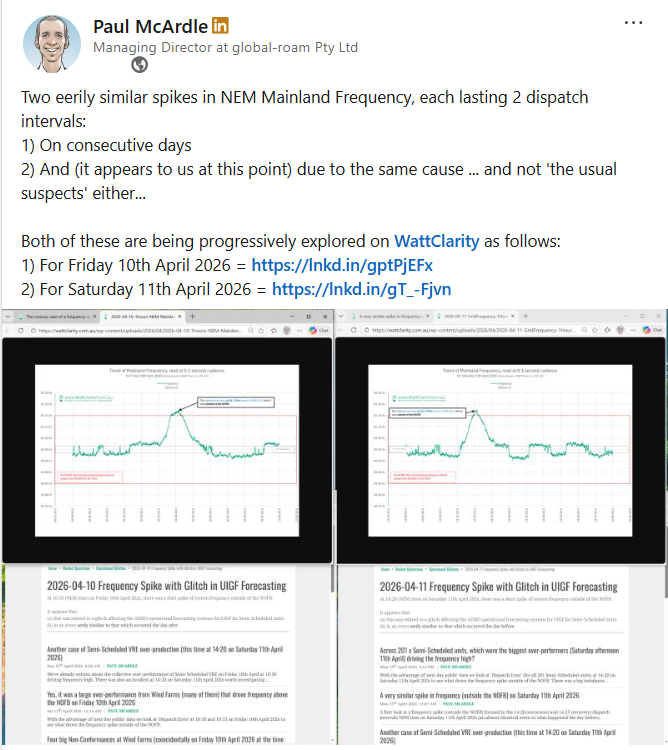
… for instance, on LinkedIn yesterday the update was here.
This was with respect to the nearly identical frequency glitches experienced in recent days:
- Progressively explored here pertaining to (10:30 on) Friday 10th April 2026; and
- Progressively explored here with respect to (14:20 on) Saturday 11th April 2026.
A number of stakeholders in the NEM have reached out to me following this to express their concerns about system stability and control with these types of events (especially in the light of their opacity).
So we’ll continue to peel layers off the onion to help explore (and then explain):
- the causes of the event
- the implications (from a system perspective); and
- the costs and other implications, for individual participants.
Apologies in advance that this article will be cryptic for those who don’t have as much background … but will be the ‘see, I told you so’ evidence that will continue other internal conversations already commenced by others who’ve more awareness of these concerns.
Source of the Availability, feeding into NEMDE
For those not so familiar with the operation of Semi-Scheduled units (i.e. Wind Farms and Solar Farms) there are three pieces of background to be aware of:
Reminder #1) The ‘Availability’ for the unit for a given Dispatch Interval that feeds into NEMDE can come from various sources
… as a first step, you might like to re-read Linton’s ‘What inputs and processes determine a semi-scheduled unit’s availability’ article.
Reminder #2) One of the sources can be a generator’s own Self-Forecast
… but beware of ‘games that self-forecasters can play’.
Reminder #3) The Semi-Scheduled units operate very differently than the (fully) Scheduled unit:
(a) the Scheduled unit must follow its Target
… remembering that ‘there are actually several different ramp trajectories that are material to dispatch in the NEM’
(b) whereas the Semi-Scheduled unit obligations are different depending on the Semi-Dispatch Cap flag status:
i. If the flag is OFF, then the unit follows the (wind or solar) energy resource
ii. If the flag is ON, then the unit needs to respect the unit’s Target as a Cap on output … it can deviate to the extent of the (wind or solar) energy resource.
… remembering that this was clarified with the AER Rule Change.
For the 86 x Wind Farms in the NEM
… one picture tells 86 different stories!
As noted yesterday, there are 86 x Semi-Scheduled Wind Farms spread across all 5 x Regions of the NEM that were operating through Friday 10th April 2026 and Saturday 11th April 2026. In the following graphic we include 50,568 individually coloured cells to tell the story of each individual wind farm
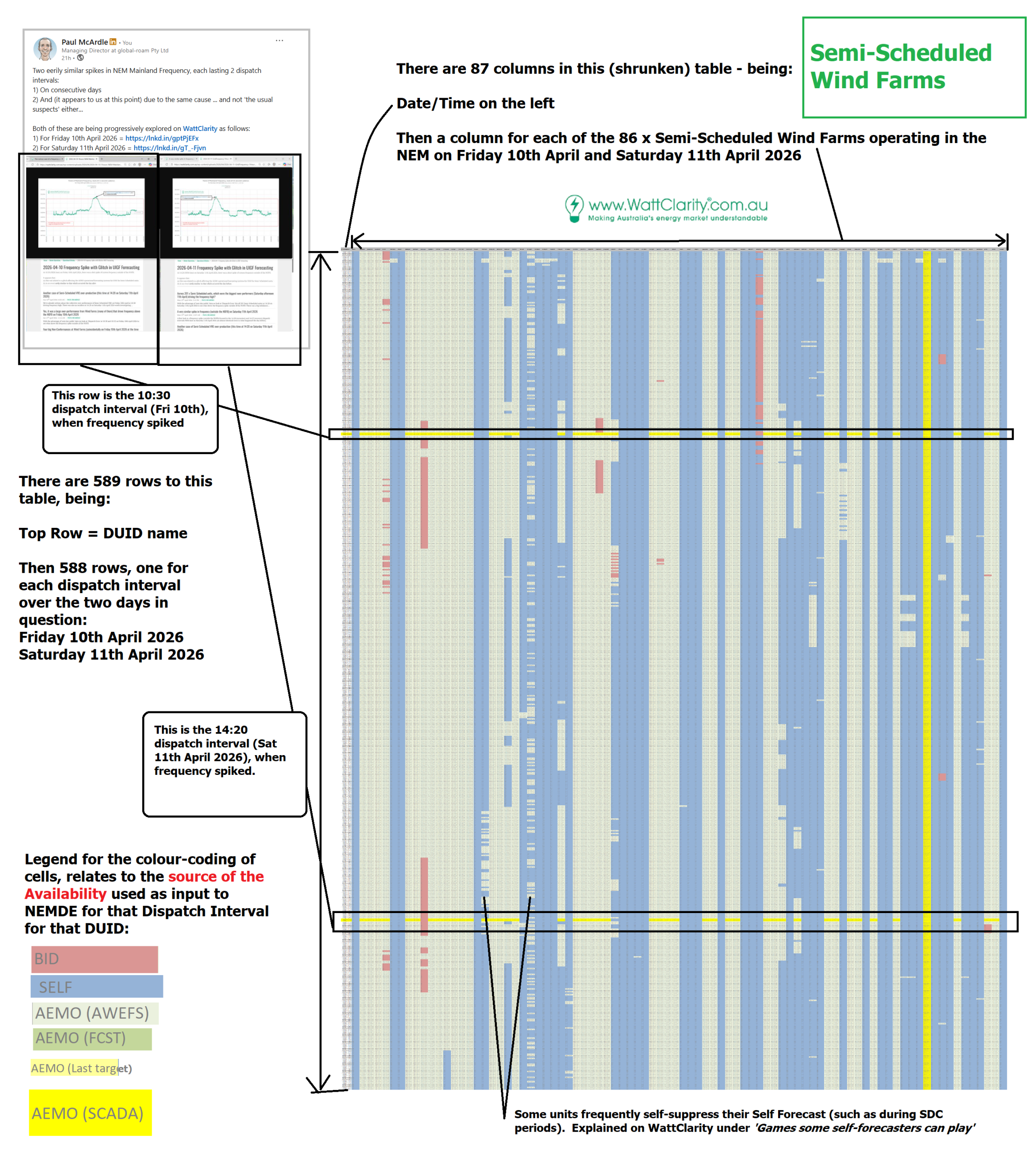
Very notable in this image are the two rows representing the timing of the frequency spikes … which lines up very well with a large number of units on AEMO (AWEFS) system flipping back to AEMO (SCADA).
1) That’s not an unrelated coincidence!
2) We’ll explain more about why that’s significant in a subsequent article.
For the 115 x Solar Farms in the NEM
… one picture tells 115 different stories!
As noted yesterday, there are 115 x Semi-Scheduled Solar Farms spread across all 5 x Regions of the NEM that were operating through Friday 10th April 2026 and Saturday 11th April 2026. In the following graphic we include 67,620 individually coloured cells to tell the story of each individual solar farm:
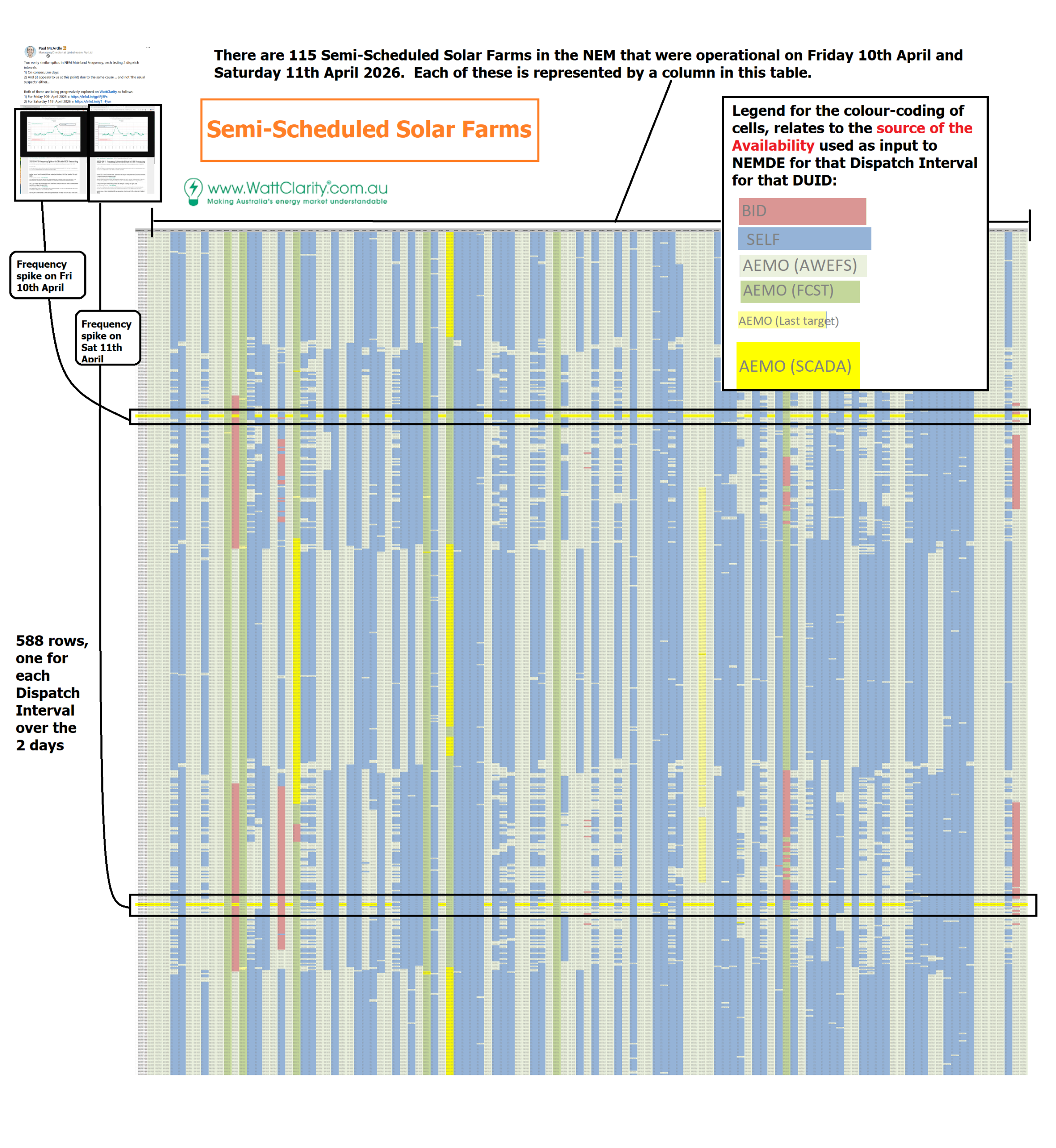
Very notable in this image are the two rows representing the timing of the frequency spikes … which lines up very well with a large number of units on AEMO (ASEFS) system flipping back to AEMO (SCADA).
1) That’s not an unrelated coincidence!
2) We’ll explain more about why that’s significant in a subsequent article.

Be the first to comment on "A big clue to one causal factor in both frequency spikes (on Friday 10th April 2026 and Saturday 11th April 2026)"