

Amongst the many reams of (virtual) newsprint that have emerged since the latest round of turmoil began in the middle east, I did notice the ABC article ‘Fuel rationing a chance in Australia if war continues to trim global oil supplies, experts say’ by Daniel Ziffer and Gareth Hutchens and published a week ago, Monday 16th March 2026:

A specific comment in the ABC article
What particularly jumped out to me was some particular aspects of this passage:
‘A failure to plan ahead, and panic buying needs to stop
Retired air vice-marshal John Blackburn agrees that Australians will have to adapt their behaviour if the Middle East war is prolonged.
“We will have to adjust our fuel consumption and how we do things in this country, a type of rationing, if the Middle East issue doesn’t get resolved,” he told the ABC.
“What we’ve got to do now is start to take measures to prepare if [the war] doesn’t solve itself.”
He said Australia’s political leaders had failed for years to plan for a situation like this, and the fact that we only had two oil refineries left in the country was symptomatic of our failure to plan ahead.
“I have had people in the Department of Energy 10 years ago tell me they didn’t care if we didn’t have any refineries because it was cheaper to import refined fuel,” he said.
“I did somewhat sarcastically ask that individual, ‘Were they an economist?’ and I tried to explain the difference between ‘just in time’ and ‘just in case’, because there was no concept of [fuel] security. The assumptions were huge.”
Australia is one of the biggest energy exporters on the planet, as the world’s third-largest exporter of LNG and the biggest seaborne supplier of thermal and metallurgical coal. But when it comes to oil the country is horribly exposed.
He said politicians had to start explaining the reality of the global market to Australians, including the fact that we import 90 per cent of our fuel.
And he says recent panic buying of petrol and diesel in Australia had only made things worse, because our fuel system was not built for huge demand shocks like that.
“The reason we’re running into problems is that people seeing what’s happening in the Middle East are running around trying to buy extra stocks in case of interruption,” he says.
“So in some areas, [there’s been] about a 35 to 40 per cent increase in demand. Our system is not designed to do that.
“It’s not a problem with the supply coming into the country at the moment or the processing; it’s our behaviour that’s causing the system itself to break down.
“We’ve got to stop panic buying,” he says.’
With particular respect to the current events in the Middle East I’ve seen people (including at both extreme of the Emotion-o-meter) referencing these events as evidence that we should:
- either increase fuel stocks onsite in Australia; or
- accelerate the transition to renewables and electrify transport.
… but it’s much more rarely that I have seen people make the case that we should be doing both.
Where have I heard that comparison before?
In terms of the perils of ‘just in time’, readers will understand that it did not take long at all for John Blackburn’s words to trigger the memory that we’d actually written about this before … but in the context of the risks of a poorly thought through energy transition:
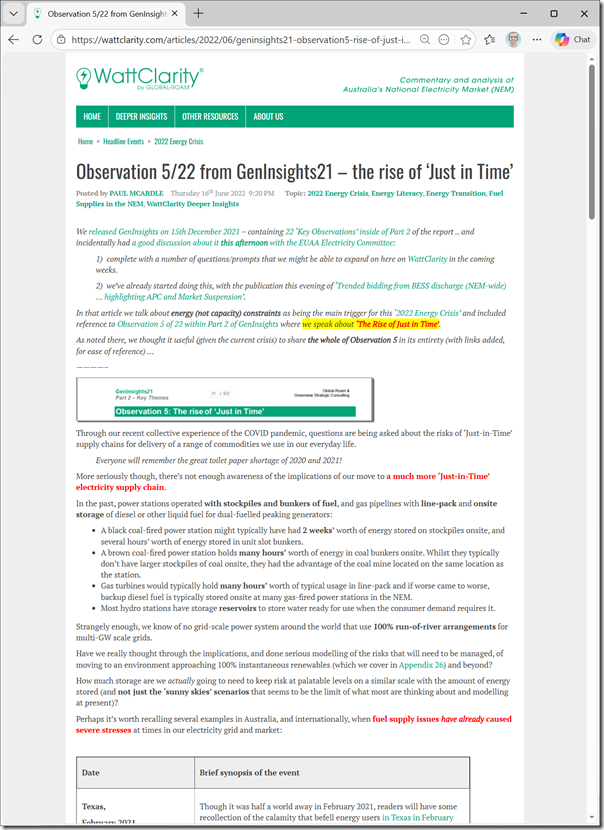
It was back in 2021 (in our GenInsights21 release) that we wrote about ‘the rise of Just-in-Time’ as an important (and massively overlooked) implication of the transition:
1) from the old ‘Baseload + Peaking’
2) to the new ‘VRE + Shaping + Firming’ (i.e. explicitly calling out the need to think of Shaping separately from the need for Firming (such as for HILP events), as noted for the NEM in the Nelson Report).
And (unfortunately) my sense is that
1) We still don’t have enough really understanding that we need much more than short-duration storage to provide enough resilience to this new energy system (especially if it’s going to be even more central to our economy if we electrify transport and so on).
2) And yet, as noted in May 2023 and again in August 2024 we’re not building enough Shaping + Firming capacity (before even considering the depth of storage).
3) Especially once one considers a bit of sleight-of-hand that’s taken place in terms of scenario ranking and the positioning messages attached in our central planning documents, such as the ESOO:
(a) As discussed in October 2025 with the NEMdev audience;
(b) And in February 2026 at the ASX Symposium audience;
etc…
So, in the same way that the current machinations in the Middle East provide the opportunity for us to consider and implement both:
Task #1) Increasing fuel stocks onsite in Australia; and
Task #2) Electrifying transport;
We should also be using this as another reminder…
Task #3) To ensure our electricity grid is as resilient in future as we need it to be.
… because it seems to us that we’re lacking in this regard.
That’s one thing that jumped out to me in a very quick scan of the recent Final Report from ENTSO-E into the Iberian Blackout.

Particularly striking (and I think underdiscussed?) is that transport fuel security & 1-in-N-year electricity system resource adequacy look to have the same least-worst solution: giant tanks storing a few dozen PJ of diesel to hedge domestic transport needs against foreign conflict *and simultaneously* hedge dual-fuel GTs against gas network constraints through long periods of high residual demand. That’s two rare and uncorrelated events, so there’s no reason you can’t use the same assets to do both simultaneously while deploying renewables and EVs as fast as possible to reduce fuel demand wherever possible.