

Callum’s already noted ‘Callide C3 & C4 unexpectedly trip’, shortly after it happened on Thursday afternoon 15th January 2026.
Since that time we have published a number of articles to progressively explore what happened, and it’s useful here to flag two articles:
- Yesterday evening we posted ‘Simultaneous with trip of Callide C3 and C4 (frequency impacts … a first look)’ with reference to our own internal log of system frequency at 0.1 second cadence
- and this morning we posted ‘Charting the 4-second data following trip of Callide C3 and C4’ utilising the AEMO 4-second data
Both data sets seemed to broadly confirm that:
- with the coincident trip of the Callide units (at ~16:55:12 by AEMO clock or 16:55:21.7 by ours) the frequency dropped sharply, but stayed within the NOFB;
- but was dragged lower afterwards, outside of the NOFB:
- perhaps 49.803 at 17:02:16.1 in our data logger (albeit with the caveats noted here)
Which prompted me to utilise the ‘Trends Engine’ within ez2view to create the following two charts of ‘Dispatch Error’ for various groups of units.
Coal unit groupings
In the first image we show three (coal-centric) series trended:
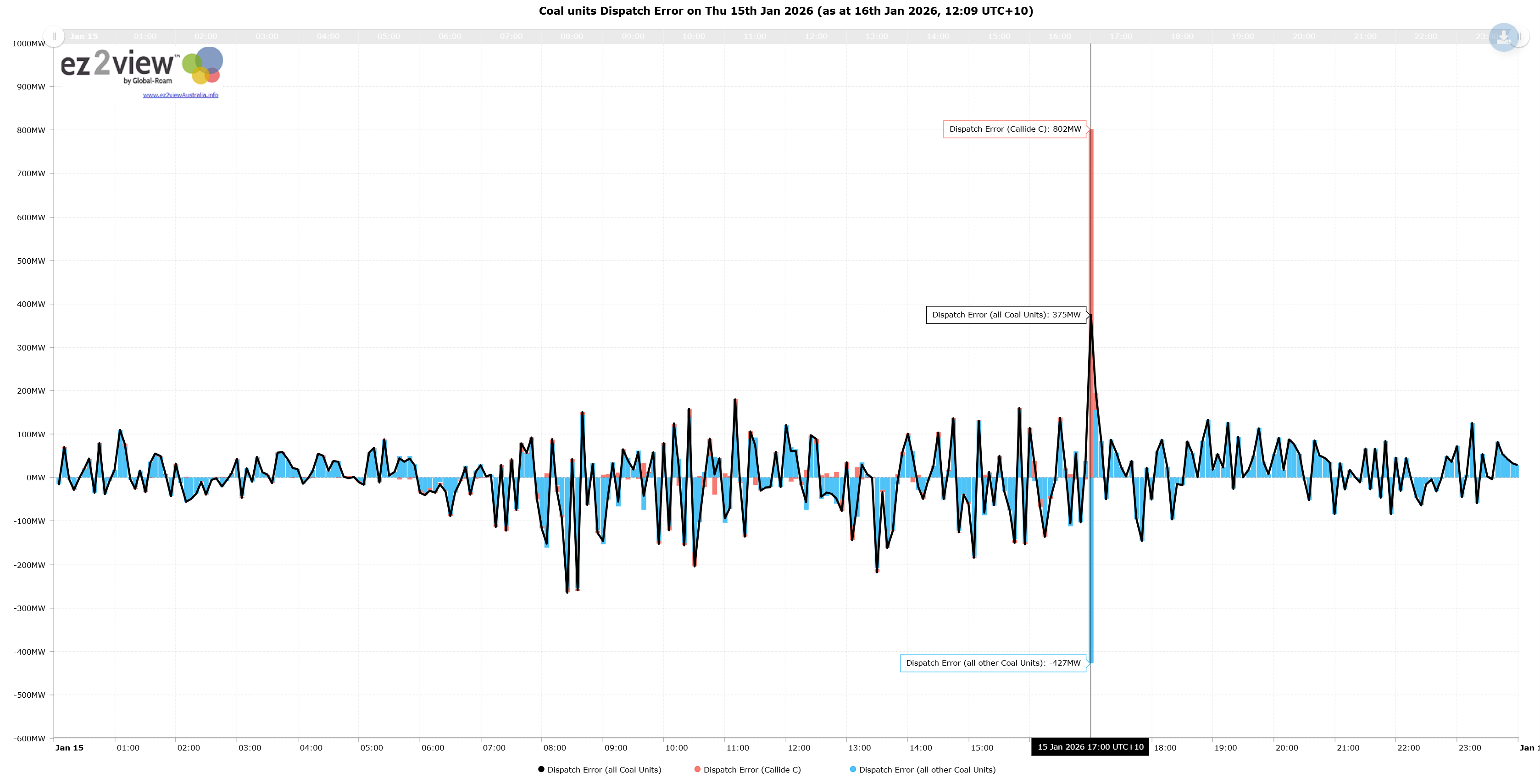
We see:
1) Of the colours:
(a) The black line is the aggregate Dispatch Error across all coal units;
(b) Blue bars are Dispatch Error for all coal units except Callide C
(c) Red bars are Dispatch Error for the two Callide C units
2) And particularly with respect to the 17:00 dispatch interval (NEM time):
(a) there’s clearly a separation!
(b) we noted yesterday that this was the interval in which the FinalMW was 0MW for both units.
(c) Whilst the Callide C units produced a large (and very unhelpful) under-performance of 802MW in this dispatch interval …
(d) the rest of the coal unit fleet rallied around and helped ‘save the day’ (yikes*) by producing a beneficial over-performance of 427MW to help offset the Callide C impact.
* frequent readers will recall how I really dislike such a term!
So, in summary, the net effect of the coal units was an unhelpful 375MW under-performance in the 17:00 dispatch interval.
What about the other types of units
What about the other types of units*?
* readers need to recognise that we can only speak of visible contributions, not the invisible ones such as rooftop PV, other forms of DER, and Non-Scheduled units etc…
Here’s a copy of the same query we’ve used before, now focused on Thursday 15th January 2026:

Unfortunately what we see here did not really surprise me, :
1) Because we’ve been writing about ‘VRE under-performance dragging frequency down’ for quite a few years now.
… and these concerns (even now) don’t seem to be widely acknowledged
2) Just in pure numerical terms:
(a) The aggregate underperformance of the Callide C station with the coincident trip amounted to 802MW
i. Which, lets be clear, was a major contributor to the frequency weakness
ii. Albeit that (thankfully) the other coal units stepped in to help moderate the impact
(b) But surely it should be alarming more people that the coincident weakness of the Large Solar units (at 859MW) was larger than the effect of two coal units tripping coincidentally!
… of course, readers need to consider the different timescales involved, as Stephen Wilson illustrated some years ago.
3) It’s also not a surprise to see that collectively the biggest helpful responses
(a) the other coal units, as noted above
(b) and also batteries!
(c) plus a meaningful contribution from hydro on this occasion
4) Rounding the list out:
(a) A small helpful contribution from gas (I’ve not checked, but suspect not many units online at the time);
(b) Plus also a small helpful contribution from wind
… which I’m guessing is purely coincidental.
This is another episode that makes me wonder how long we need to keep waiting for some form of corrective action to be taken:
1) The Final Report of the Nelson Review was disturbingly silent in even acknowledging that this is an issue
2) AEMO mentioned vaguely (such as here) that they are thinking of increasing the amount of Regulation FCAS
…. but how long do we need to wait?
3) Even when that change finally comes into being, will it be enough?

The obvious question here is whether it was merely coincidental that immediately after the Callide C trips, aggregate off-target level for semi-scheduled solar leapt to nearly double the level it had hit in any previous interval on the day?
Or did the frequency disruption due to Callide somehow trigger some solar farms into underperforming over the next 5 minutes? – I can’t quickly think of a mechanism, but it does seem strange.