

This afternoon our notifications alerted us to that a trip of both the Callide C units have tripped from 800MW to zero with in a single interval at around 5pm. This has caused a large drop in frequency to occur that has since recovered.
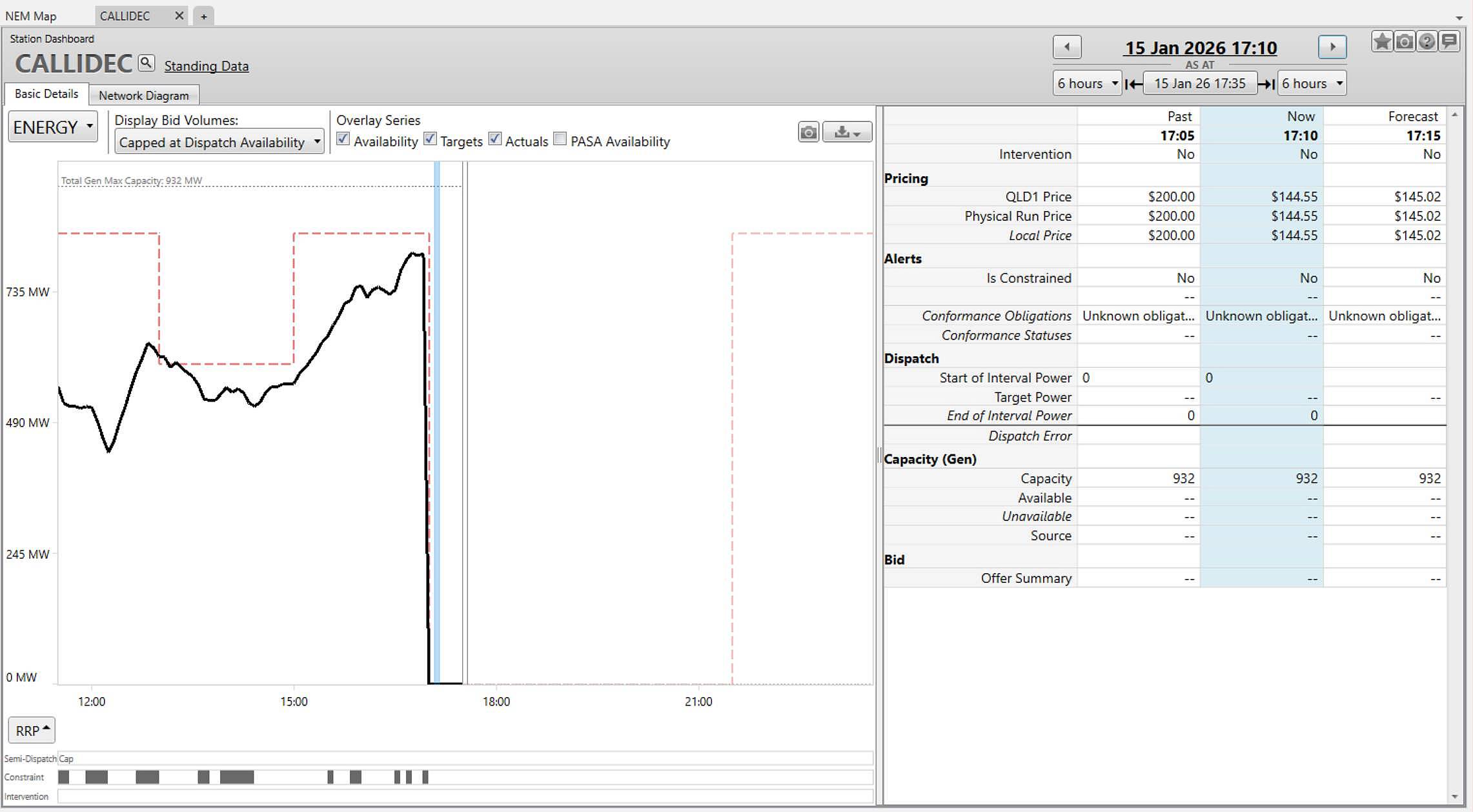
Station Dashboard view of the Callide C Trip in ez2view, 15th Jan 2026
A short time later the AEMO have posted a market notice acknowledging the event
Non-credible contingency event – QLD region – 15/01/2026
AEMO ELECTRICITY MARKET NOTICE.
Non-credible contingency event – QLD region – 15/01/2026
At 1655 hrs the Callide Power Station C3 and C4 units tripped.
AEMO did not instruct load shedding.
AEMO has not been advised of any disconnection of bulk electrical load.
The cause of this non credible contingency event is not known at this stage.
Manager NEM Real Time Operations
More to come as information becomes available
Date: February 2026
From: A Retired Power Plant Operator (20+ Years Experience)
Subject: Formal Record of Technical Negligence and the Path to Professional Safety
1. EXECUTIVE SUMMARY
As a former Marine Engineer and 20-year power plant operator, I am providing this record to ensure the 2021 Callide C4 explosion is never repeated. The incident was not a random technical fluke; it was a consequence of bypassing engineered safety barriers for production goals. To restore safety and insurability to the Queensland energy grid, we must move away from “in-house” company training to a Statutory National Standard for plant operators.
2. THE TECHNICAL “SMOKING GUN”
The 2021 disaster resulted from two specific, documented deviations from core engineering safety principles:
The Interlock Bypass: Maintenance protocols bypassed physical Castell Key Interlocks. These “trapped key” systems are designed to make it physically impossible to isolate the 220V DC protection supply while the turbine is online. By bypassing these, the turbine’s “emergency brain” was killed while it was generating power.
The Lack of HV Isolation: Management opted for “live” maintenance on critical protection circuits to avoid a planned outage. Under standard engineering practice, High Voltage (HV) Isolation is the only safe method for this work. Without it, the unit was left with zero redundancy, leading directly to its kinetic disintegration.
3. THE ECONOMIC COST OF NEGLIGENCE
The “white-wash” narrative was dismantled by the following financial and legal facts:
Total Financial Impact: Taxpayers face a bill exceeding $1 Billion for repairs, rebuilds, and grid stabilisation.
Insurance Crisis: Following the failure, CS Energy became virtually uninsurable; premiums surged by $40 Million annually.
Legal Penalty: In February 2025, the Federal Court issued a record $9 Million fine against the operator for breaching National Electricity Rules.