

On Tuesday we posted ‘A brief overview of the situation in NSW on Saturday 10th January 2026 (prior to further analysis)’.
Amongst other observations in that article, that overview highlighted that the operations of batteries (in aggregate across NSW) on Saturday 10th January 2026 appeared to be a little different than I had been expecting:
1) specifically that they did not hit peak output at the point the prices spiked above $10,000/MWh (i.e the 18:35 dispatch interval NEM time), but rather 6 dispatch intervals later (i.e. the 19:05 dispatch interval NEM time).
2) and I was curious to dig further to understand why.
So that’s part of the reason for this article.
All Batteries in NSW
In this article, we’ll draw heavily on the ‘Bids & Offers’ widget in ez2view (time travelled back to 24:00 ending Saturday 10th January 2026 and looking back 24 hours) in order to focus on battery bidding.
Here’s an aggregate view:
… remembering that post-IESS all batteries operate as Bi-Directional Units:
(a) bids (and targets) to discharge being positive megawatts;
(b) bids (and targets) to charge from the grid being negative megawatts
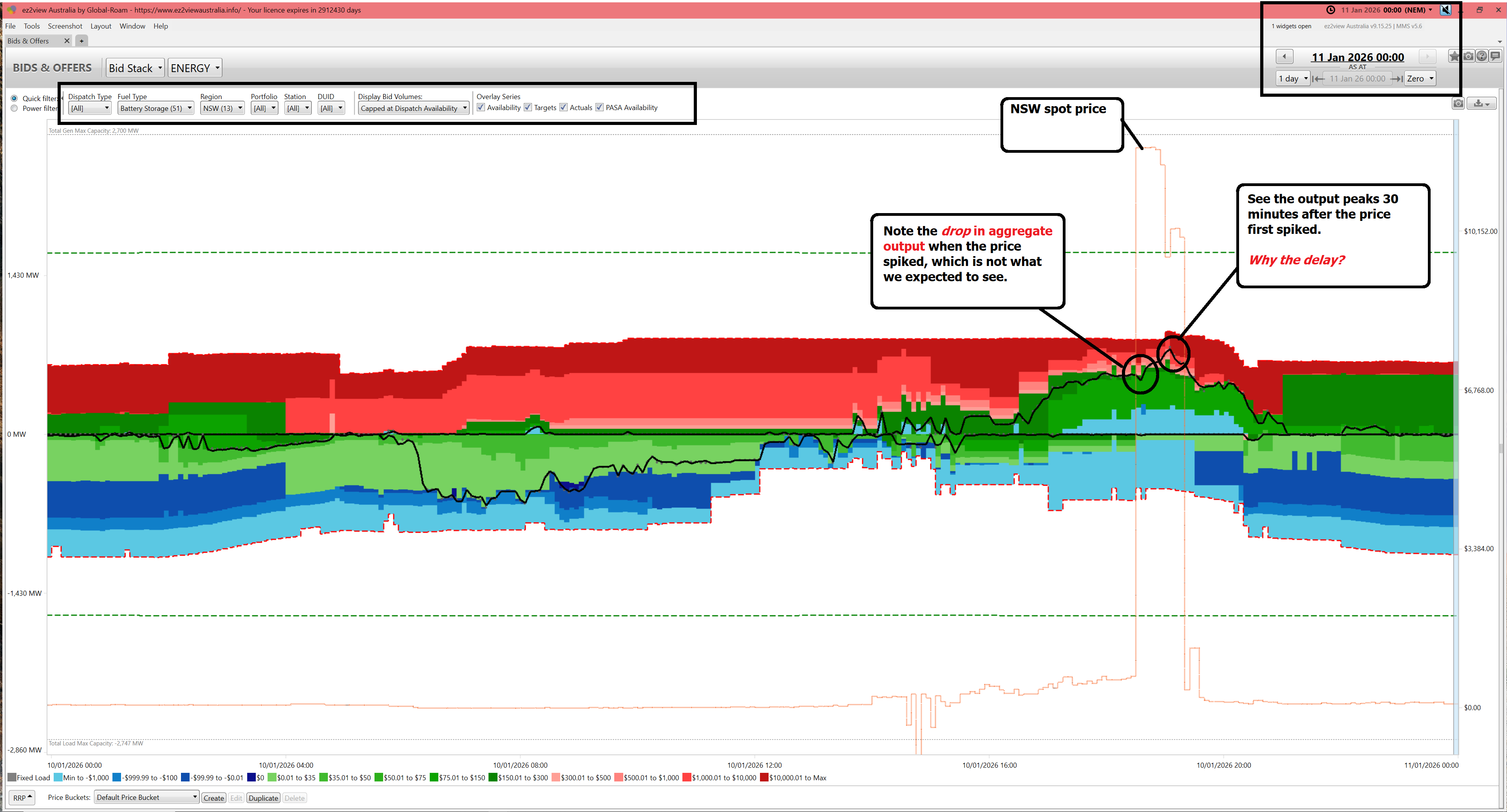
I’ve annotated the image:
1) To highlight the options that have been selected in configuring the widget;
2) But particularly with two observations that I’m seeking to explore in this article:
(a) The dip in output at the time when the price first spikes above $10,000/MWh
(b) And also the delayed ramp up to peak output.
Filtering down to specific batteries
We’ll now filter down to each individual battery in NSW (there are 13 currently registered, though some of these not yet operational) in order to see what the situation was for each of them. These are in alphabetical order …
BHB1 (Broken Hill Battery)
At the top of the list is the BHB1 unit (by AGL Energy):
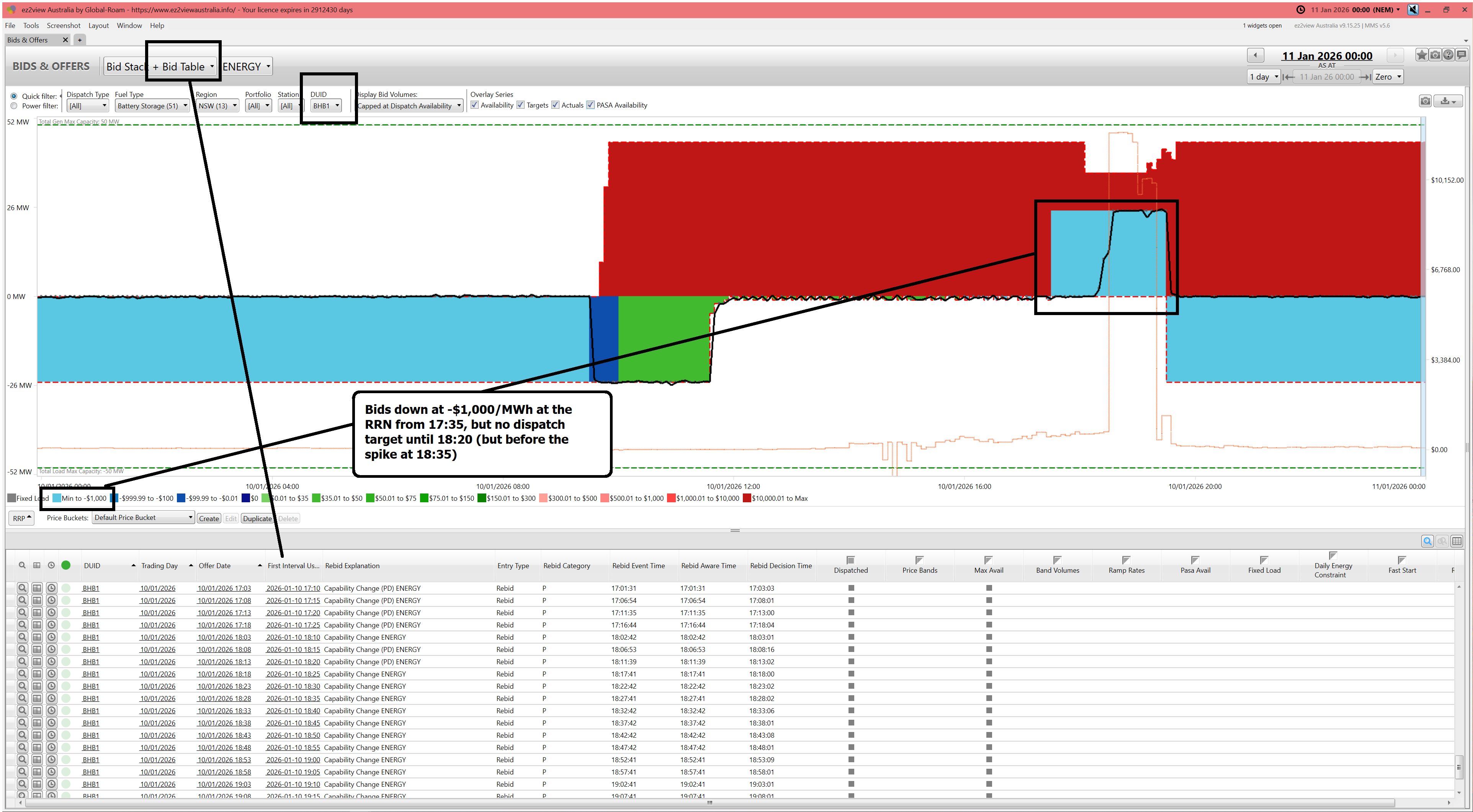
With this image …
1) Note that we’ve added a ‘Bid Table’, which some readers might find of interest with respect to some batteries.
2) Zooming into the afternoon/evening period, we see three things:
(a) From the 17:35 dispatch interval NEM time (i.e. an hour before the price spike at 18:35, not forgetting prices were already elevated then) volume was shifted down to the –$1,000/MWh bid band (at the RRN);
(b) but the unit only gained a positive target at 18:20 (NEM time)
i. which was still before the price jumped at 18:35;
ii. but later than what one would expect if just viewing dispatch through a simplistic ‘merit order bid stacking’ lens.
(c) We also see a reduction in aggregate capacity available from 18:10 (NEM time) via a rebid reason ‘Capability Change ENERGY’
… albeit that that rebid reason was used often through the day
To understand more, we need to view the unit through the ‘Unit Dashboard’ widget in ez2view focused on the same 24-hour look-back period, but with the table on the right focused on the 18:20 dispatch interval:
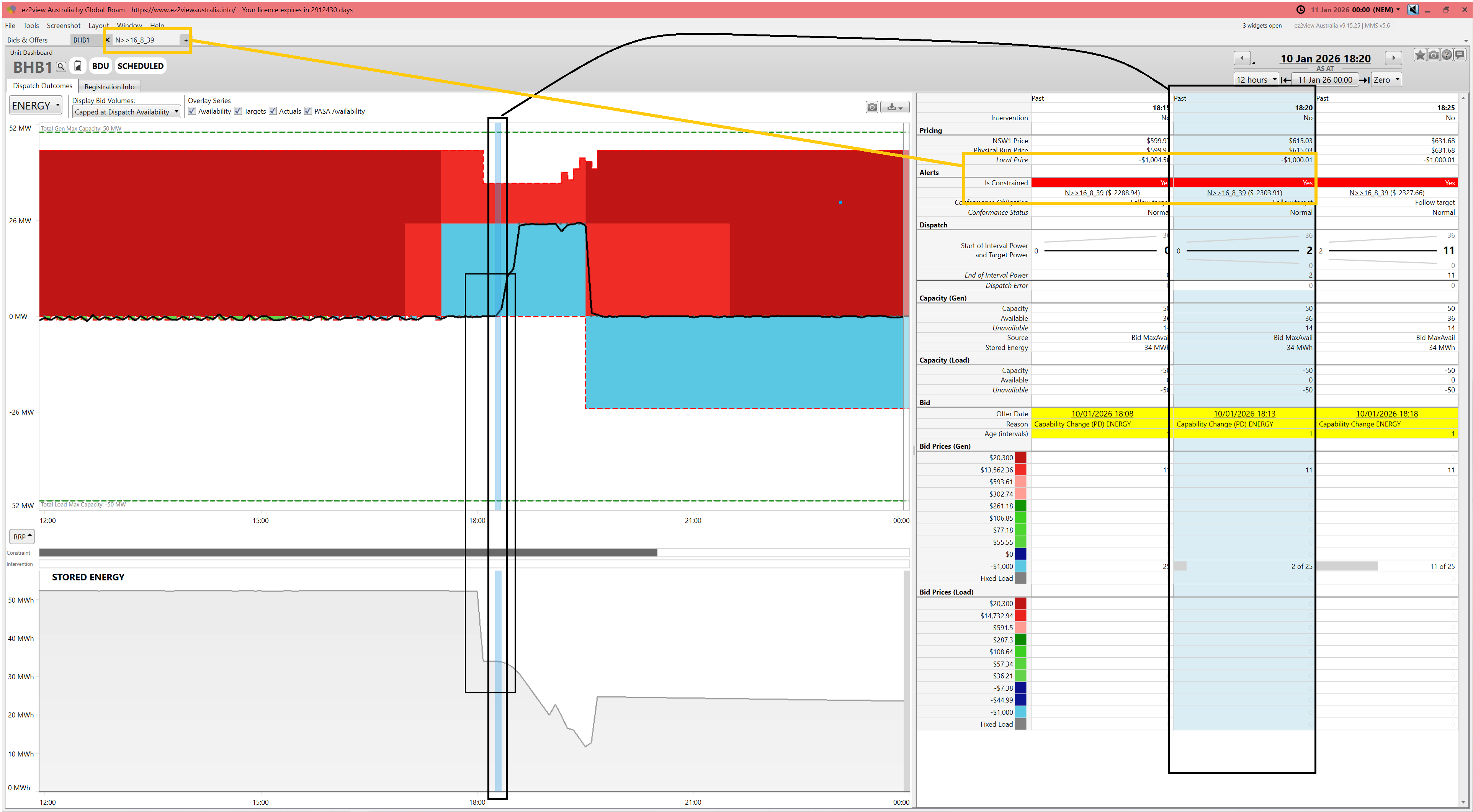
With respect to that image:
1) We can see that the culprit is the ‘N>>16_8_39’ constraint equation:
(a) Which …
i. is binding with a significant Marginal Value and driving the Local Price for this unit below –$1,000/MWh
ii. or, in layperson terms, ‘constraining off’ this unit.
(b) Noting that we already wrote about the offending ‘Long-running network outage on Avon to Marulan 330kV line in summer 2025-26’.
(c) And that we’ll see this constraint equation feature on other occasions below…
2) Worth noting that (in this image) there’s another question this poses:
(a) The question:
i. If the positive target only began at 18:20
ii. How is it that the ‘stored energy’ starts to decline before that point?
(b) But we don’t have time for that rabbit hole at this point!
CAPBES1 (Capital Battery)
Next is the Capital Battery unit:
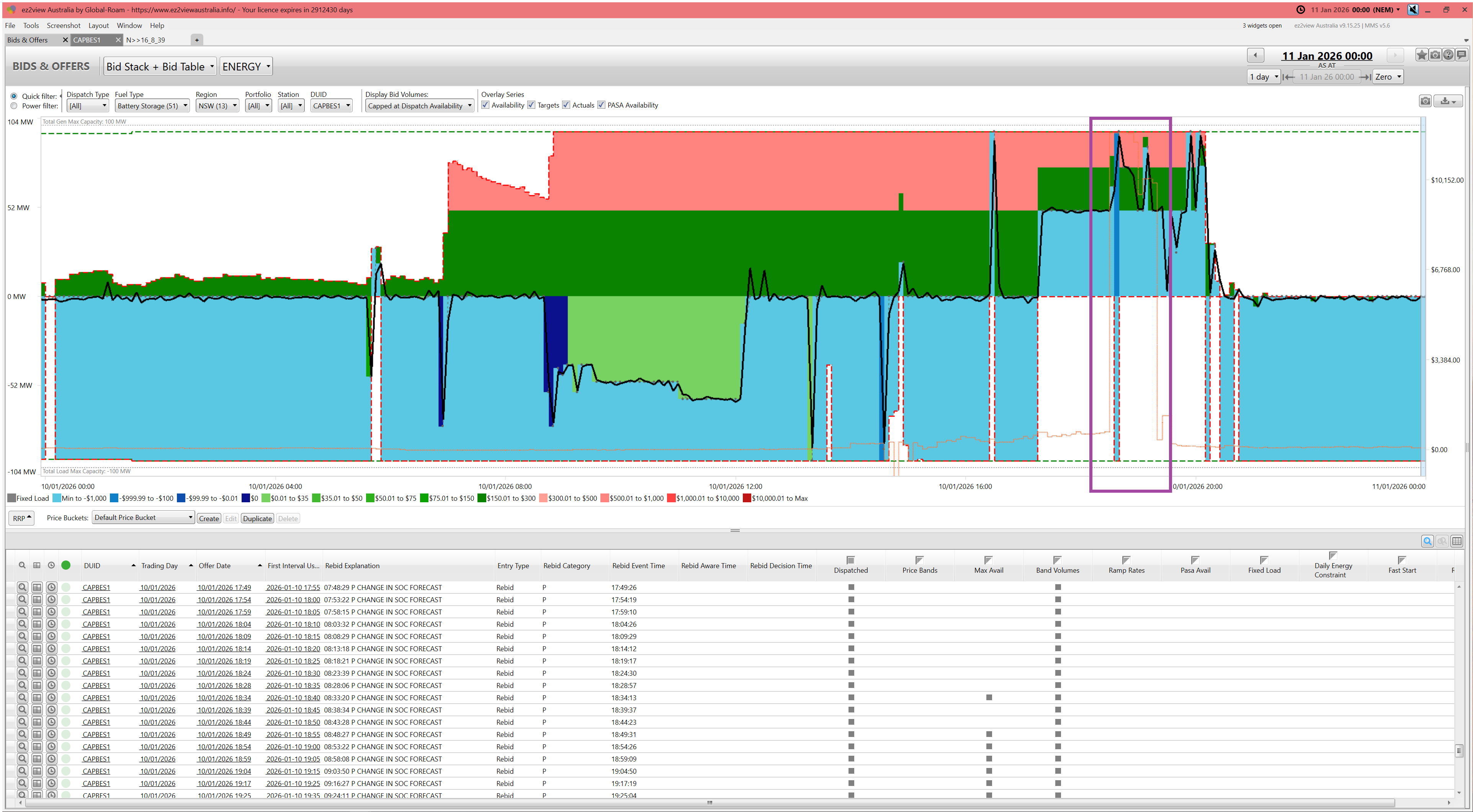
We can see that:
1) The unit’s capacity is essentially in two parts:
(a) The first 50MW bid at –$1,000/MWh at the RRN from 17:20 and through the volatile period
(b) Then 46MW bid at various prices (including $253.01 and $994/MWh at the RRN)
… excepting the 18:40 dispatch interval, where all the capacity is bid at –$649.99/MWh for reasons not explored at this point
2) So, in this case we can see the the outputs could be viewed as conforming to a simple ‘bid stacking’ lens:
(a) This is without digging further
(b) But worth noting that:
i. this unit is also on the LHS of the (bound) ‘N>>16_8_39’ constraint equation
ii. just with a less severe LHS factor (+0.6340, compared to +0.7010 for BHB1).
But we’ll move on…
DPNTB1 (Darlington Point Battery)
Next is the Darlington Point Battery unit:
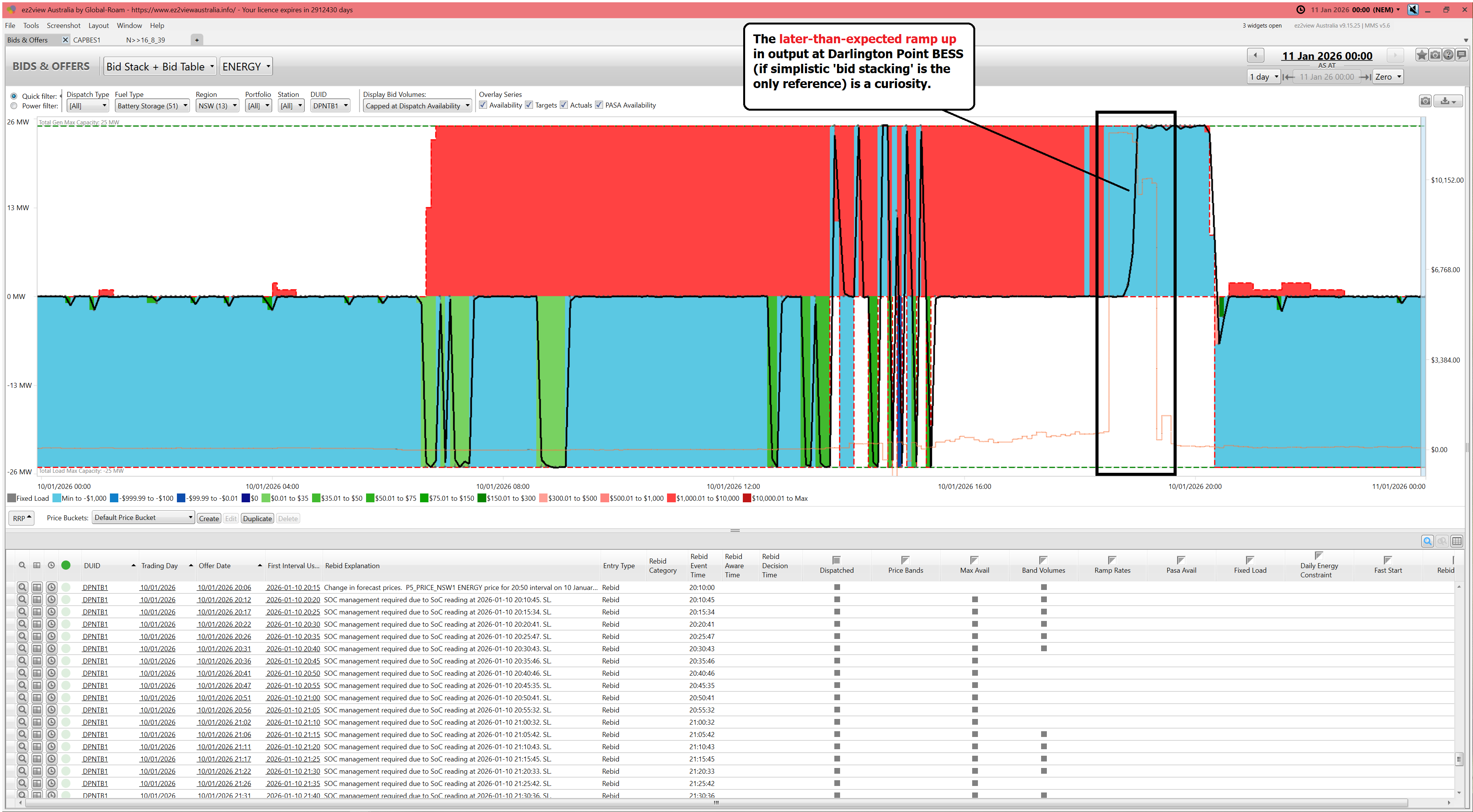
In this case:
1) We see some similarity to BHB1 above:
(a) in that the ramp up in output is later-than-expected, if only using a simplistic ‘bid stacking merit order’ paradigm;
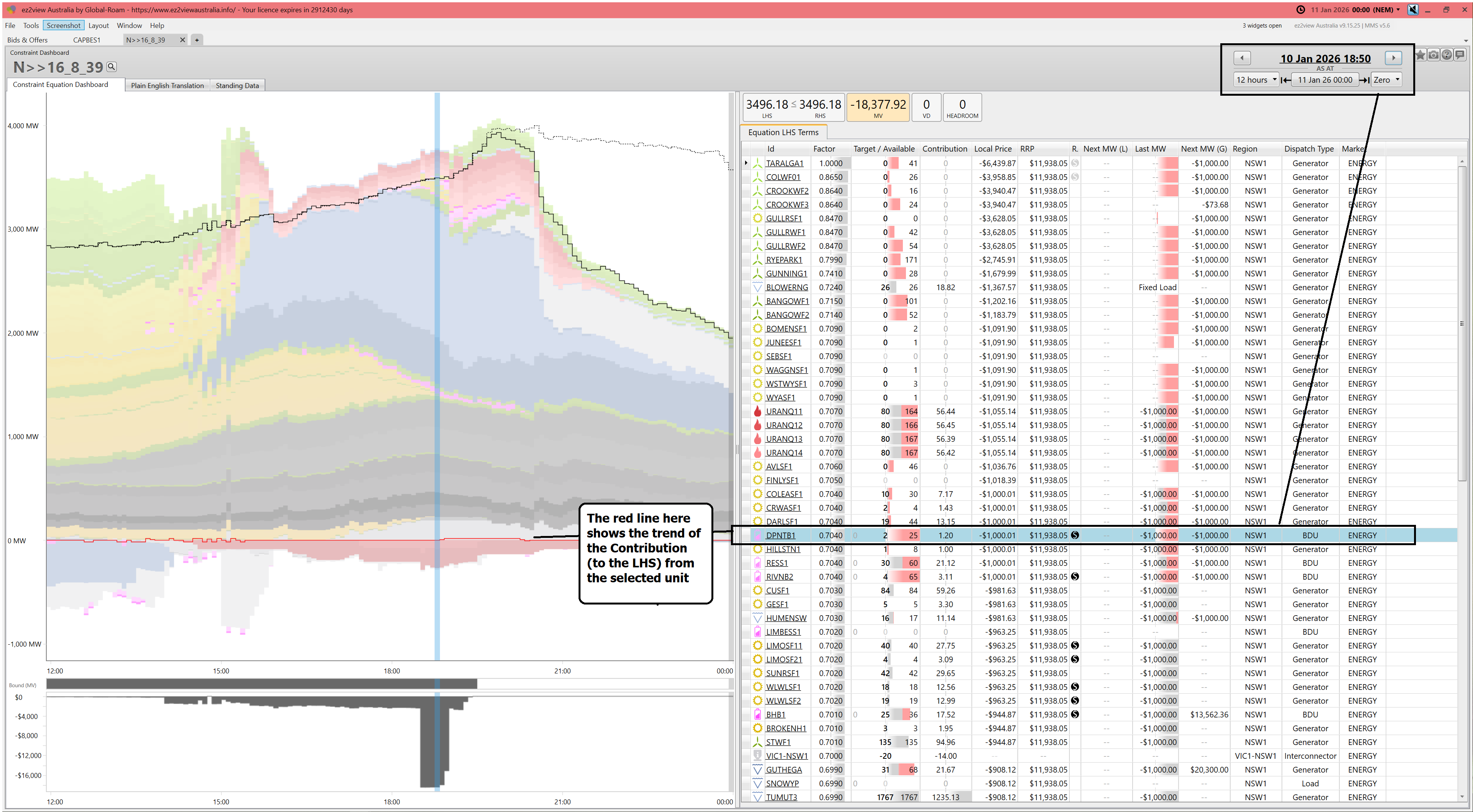
(b) that the culprit is also the ‘N>>16_8_39’ constraint equation.
2) In this case, the dispatch target only steps up to 2MW at 18:50 … which we can also see in the ‘Constraint Dashboard’ widget in this case:
Let’s move on…
ERB1 (Eraring Battery)
Next is the Eraring Battery unit:
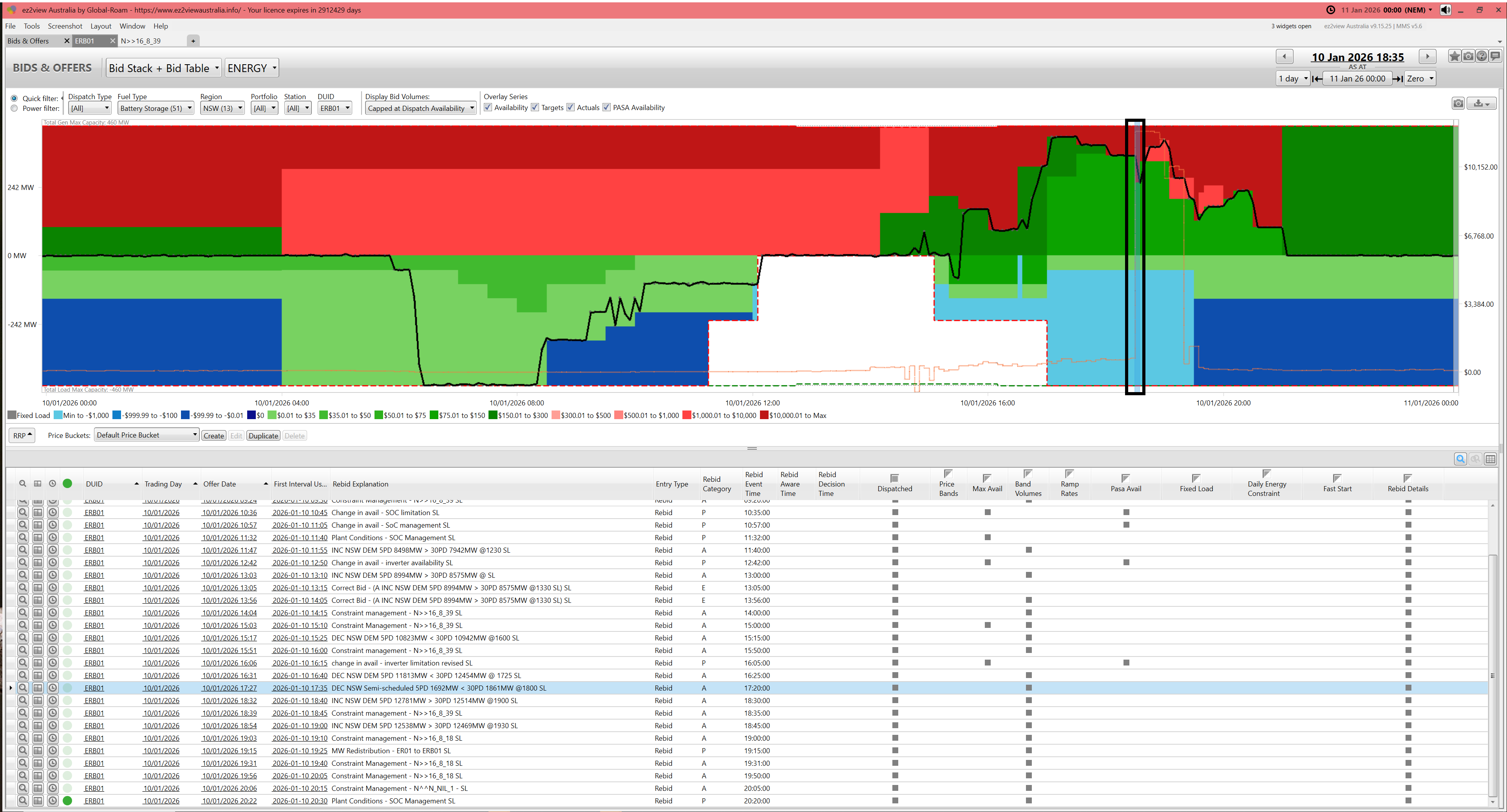
In this case:
1) Comparing 18:30 to 18:35 bid positioning, the participant shifted 95MW
(a) from an ‘in the money’ bid band ($86/MWh at the RRN) for the 18:30 dispatch interval
(b) up to an ‘out of the money’ bid band ($20,204/MWh at the RRN) for the 18:35 dispatch interval
2) But the rebid that took effect for 18:35 was placed about an hour before the spike:
(a) With the following timestamps (see background on rebidding):
i. Event time = 17:20
ii. Received by AEMO = 17:27
iii. First dispatch interval the rebid applied in = 17:35
iv. Last dispatch interval the rebid applied in = 18:35
… coincident with the the start of the volatility!
(b) and the rebid reason ‘DEC NSW Semi-scheduled 5PD 1692MW < 30PD 1861MW @1800 SL’
(c) we can see this via this snapshot from the ‘Bid Explorer’ widget in ez2view:
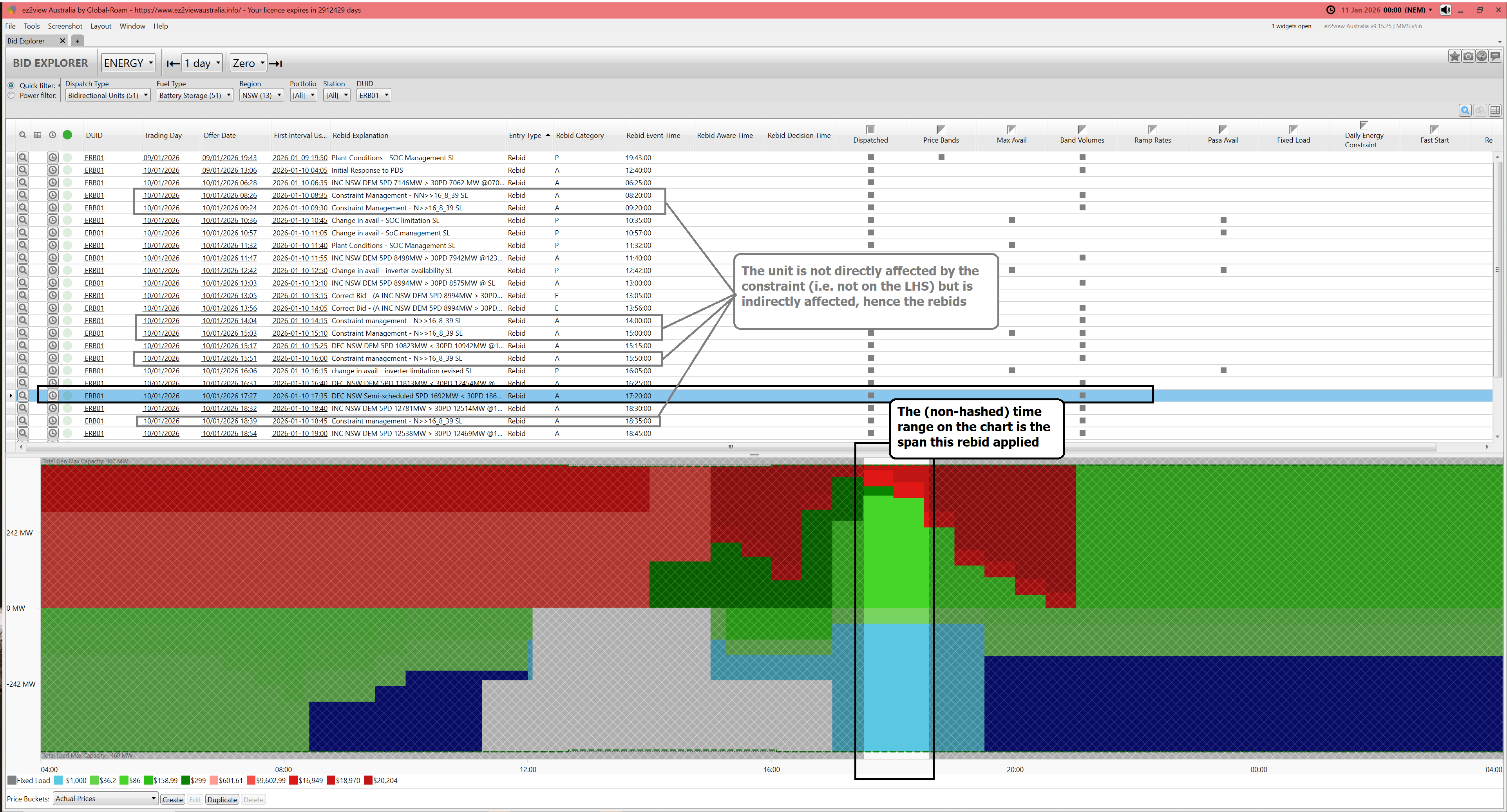
(d) as a result of the shift in volume to ‘out of the money’ bands from 18:30 to 18:35
i. the unit was dispatched down
ii. and it goes some way to explaining the price jump
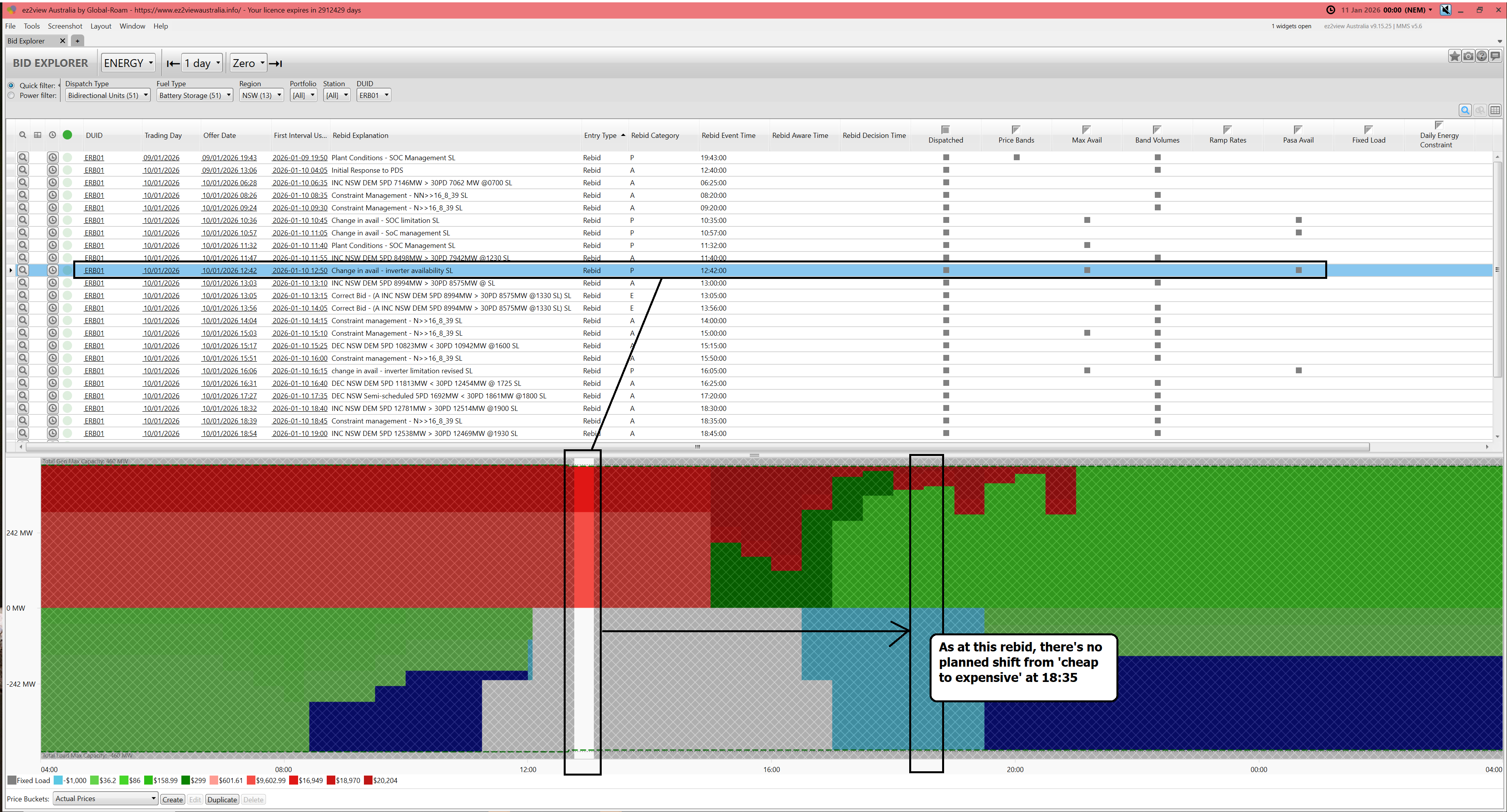
3) and, if one wanted to be pedantic, the essence of the change in volume (from 18:30 ‘cheap’ to 18:35 ‘expensive’) was put in place as early as a rebid that AEMO received at 13:03:
(a) here’s another snapshot from the ‘Bid Explorer’ widget in ez2view:
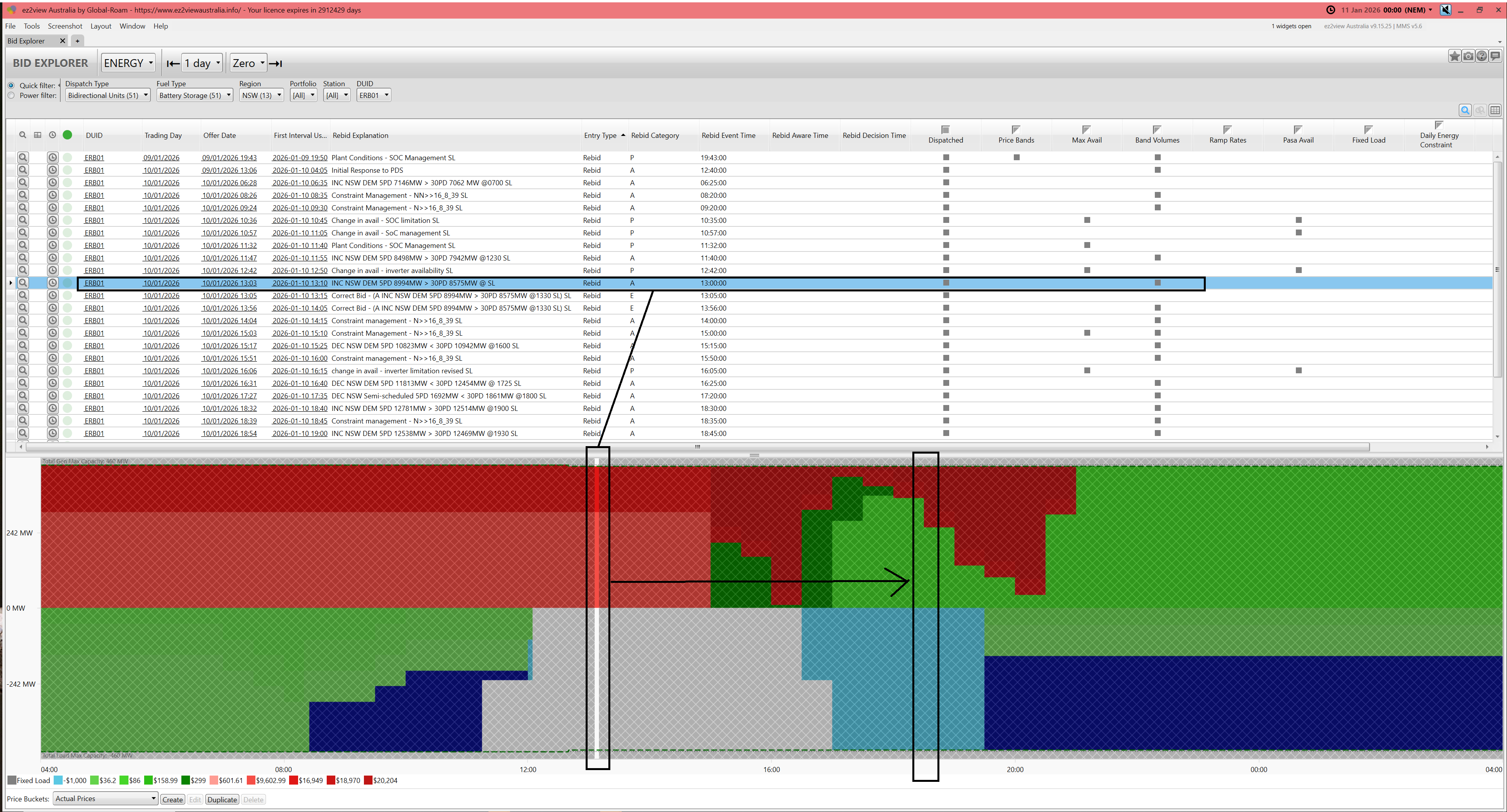
(b) whilst this rebid only ended up having effect for a single dispatch interval, we can see the difference it brought to the 18:30 to 18:35 transition by comparing to the immediately preceding rebid (that landed at 12:42):
4) What happened after the spike?
(a) Note that another rebid landed at 18:32 (i.e. shortly after the dispatch outcomes, including the price spike, were known) that changed the approach
(b) And then a rebid (one of several over the day) noting ‘Constraint management – N>>16_8_39 SL’
i. there’s that offending constraint again!
ii. even though the Eraring Battery is not on the LHS of the ‘N>>16_8_39’ constraint equation!
iii. readers will understand that shallow storage units like batteries can be significantly affected by constraints like this even if not on the LHS.
LDBESS1 (Liddell Battery)
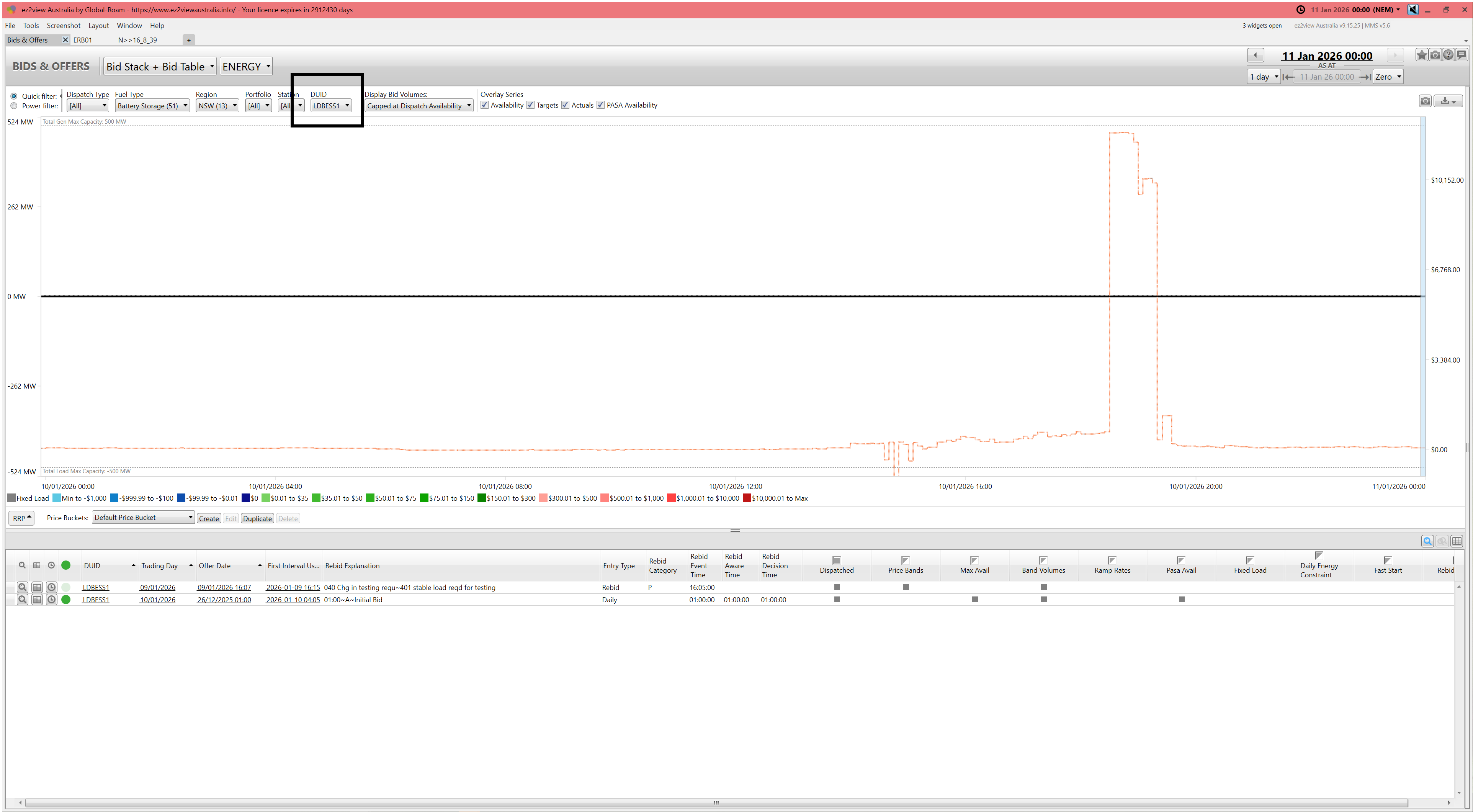
Not much to see for the Liddell Battery unit (as it’s still in commissioning):
LIMBESS1 (Limondale Battery)
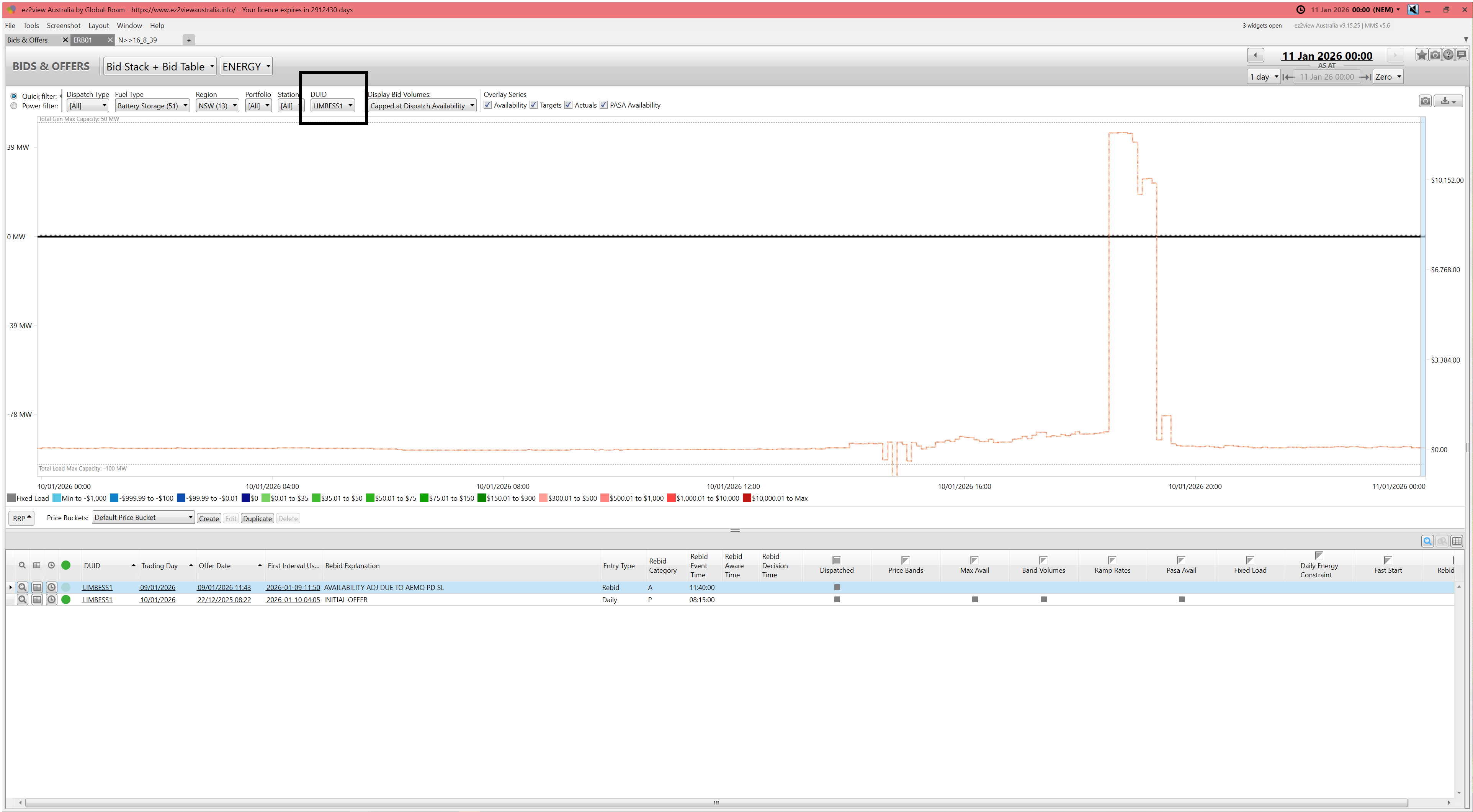
Same for the Limondale Battery unit (as it’s still in commissioning):
ORABESS1 (Orana Battery)
Same for the Orana Battery unit (as it’s still in commissioning):
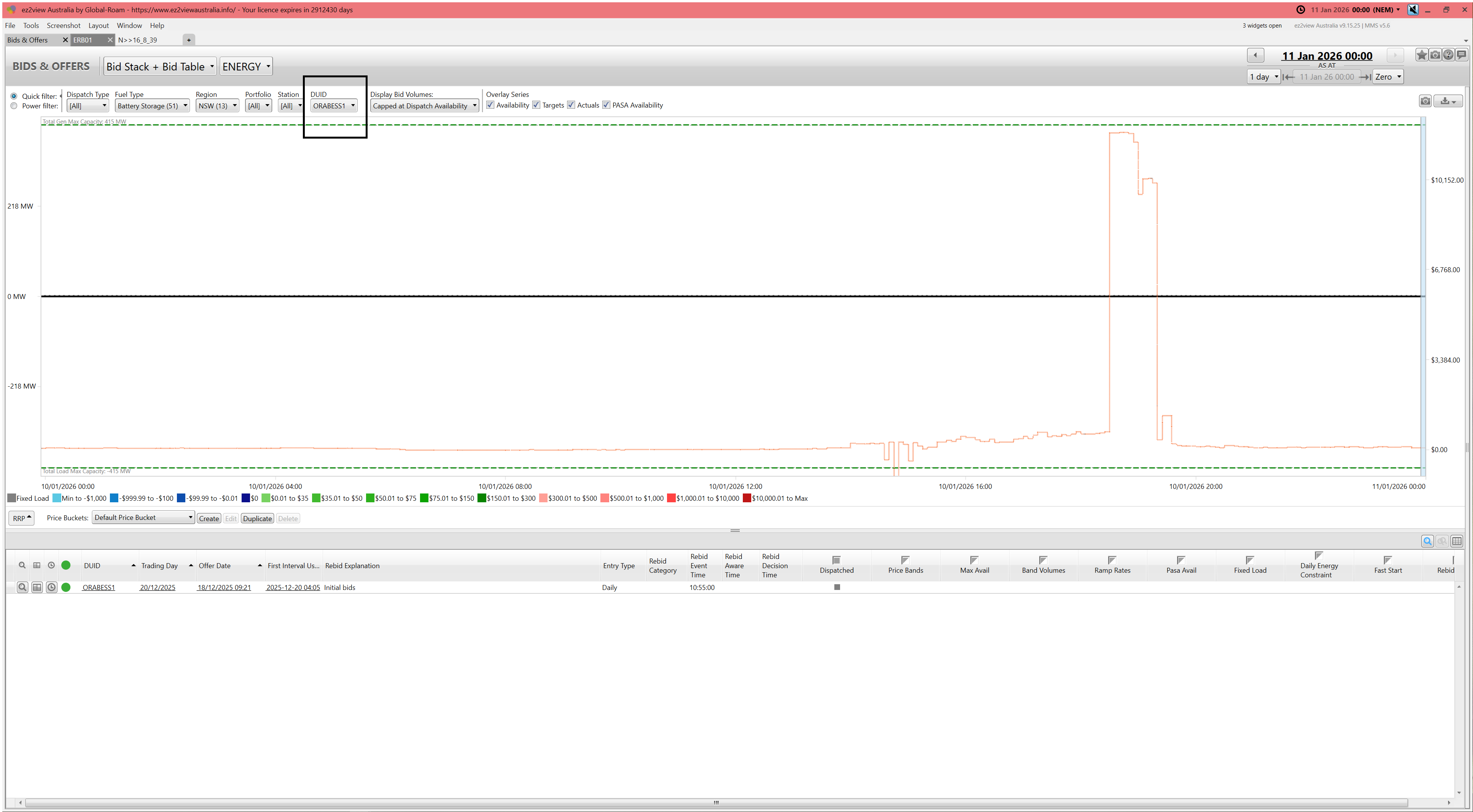
QBYNB1 (Queanbeyan Battery)
Not much to see for the Queanbeyan Battery unit:
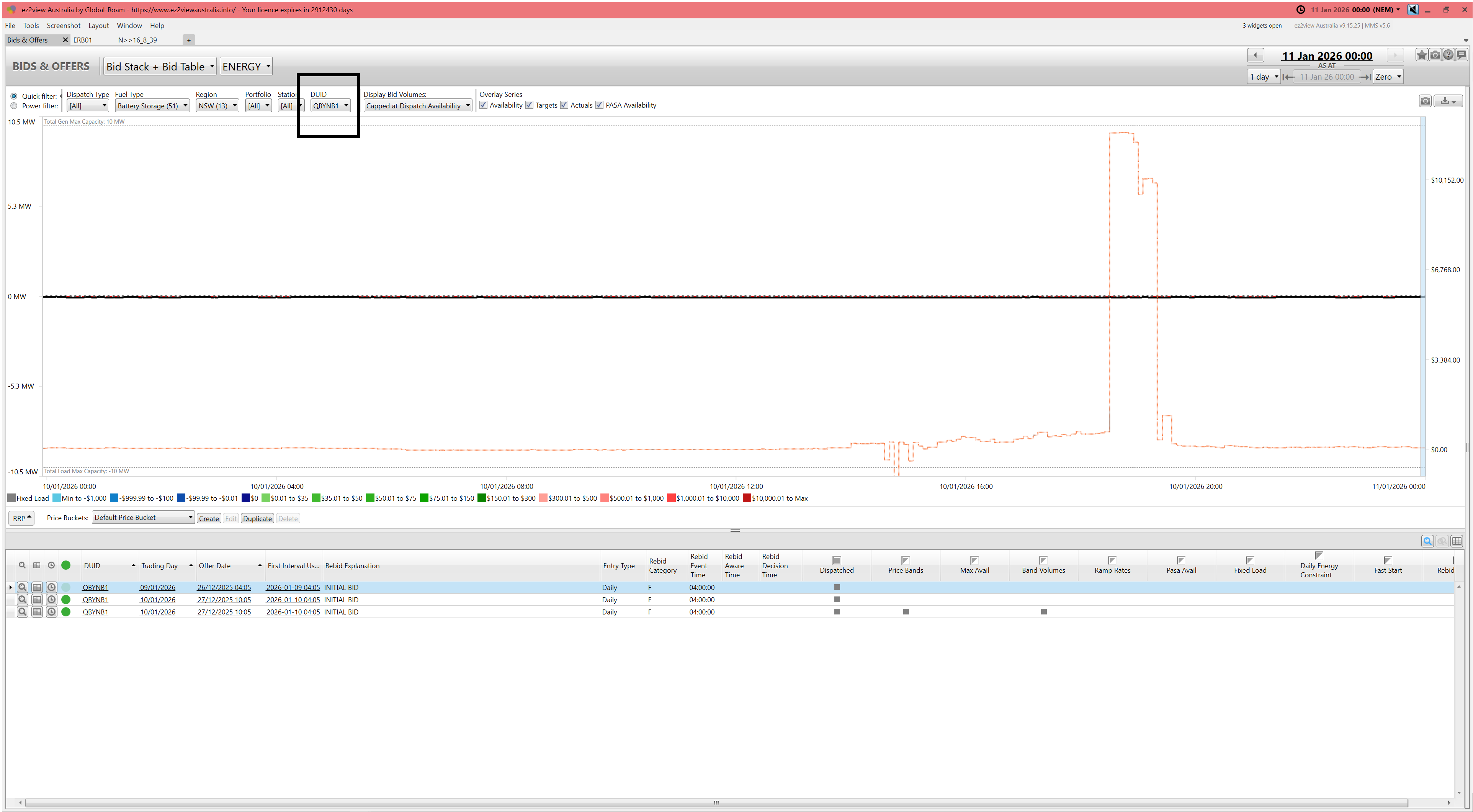
I don’t have time to delve into another rabbit hole at this point, but I’m scratching my head a bit as this unit has been commissioned, but has not really operated much since 2nd October 2025.
RESS1 (Riverina 1 Battery)
A very colourful, active, display for the Riverina 1 Battery unit (which I think is the one operated by Shell Energy):
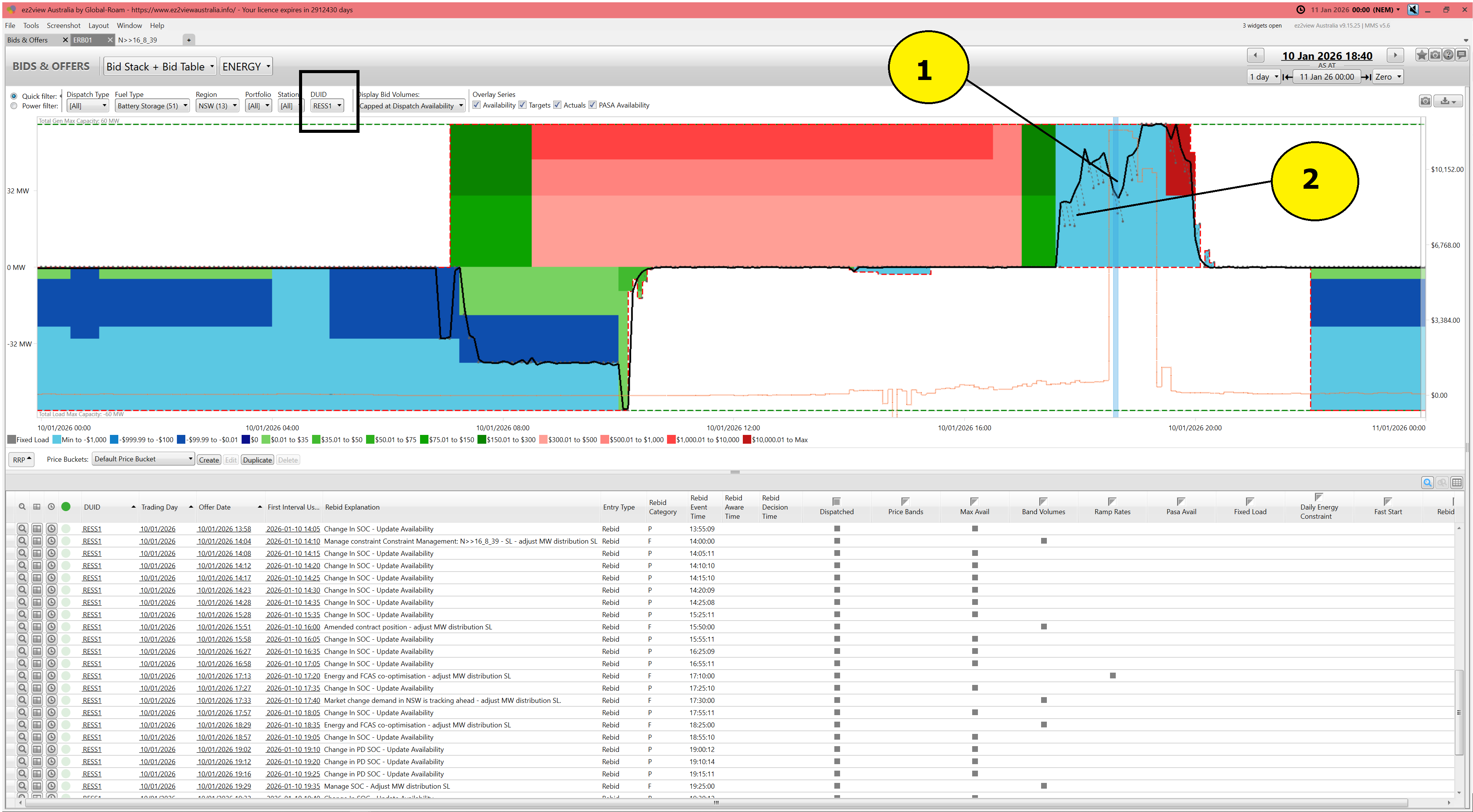
In this case, there are two things that jump out to me pretty quickly here:
1) First is the drop in output at the same time as the price spike:
(a) So ultimately similar to BHB1 and DPNTB1 above
(b) because the culprit is also the ‘N>>16_8_39’ constraint equation.
2) Second are all of the dotted lines:
(a) Which show that the AEMO was issuing Targets to ramp down …
(b) But the unit (for reasons unknown at this point – another rabbit hole) appeared to not conform with these dispatch instructions
(c) There could be various reasons for this, but I’ve not had time to explore.
(d) Some readers will note that this will have meant significantly higher revenue in the ENERGY market than would otherwise have been the case.
RIVNB2 (Riverina 2 Battery)
A differently colourful display for Riverina 2 Battery unit (which I think is the one operated by EnergyAustralia):
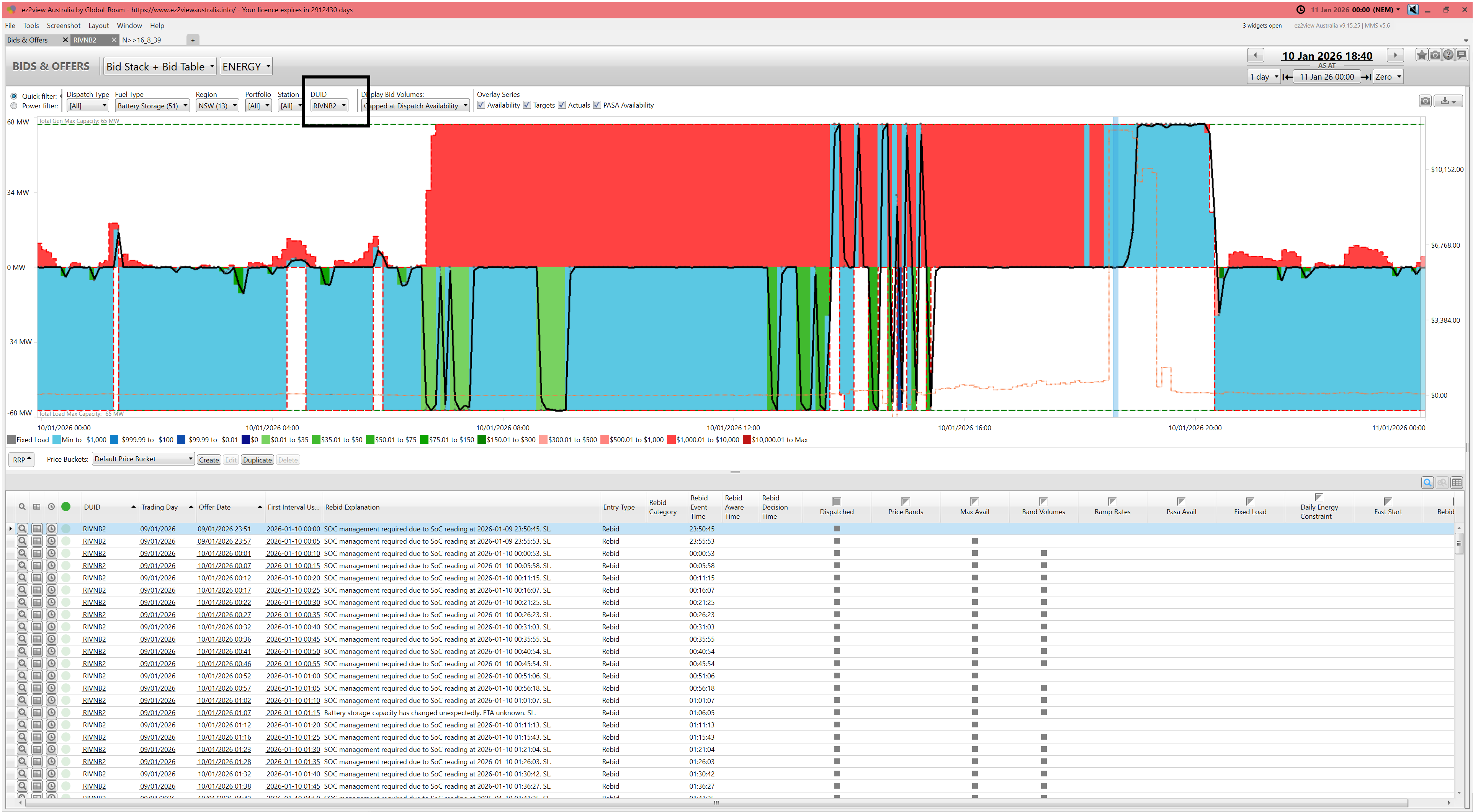
In this case:
1) The unit oscillated through the day with (discharge) bids down at –$1,000/MWh at the RRN and bids up at $1,298.89/MWh
2) And (similar to BHB1 and DPNTB1 and RESS1 above) was delayed in gaining target to discharge because of the offending ‘N>>16_8_39’ constraint equation.
SMTHBES1 (Smithfield Battery)
Also a busy display for the Smithfield Battery unit:
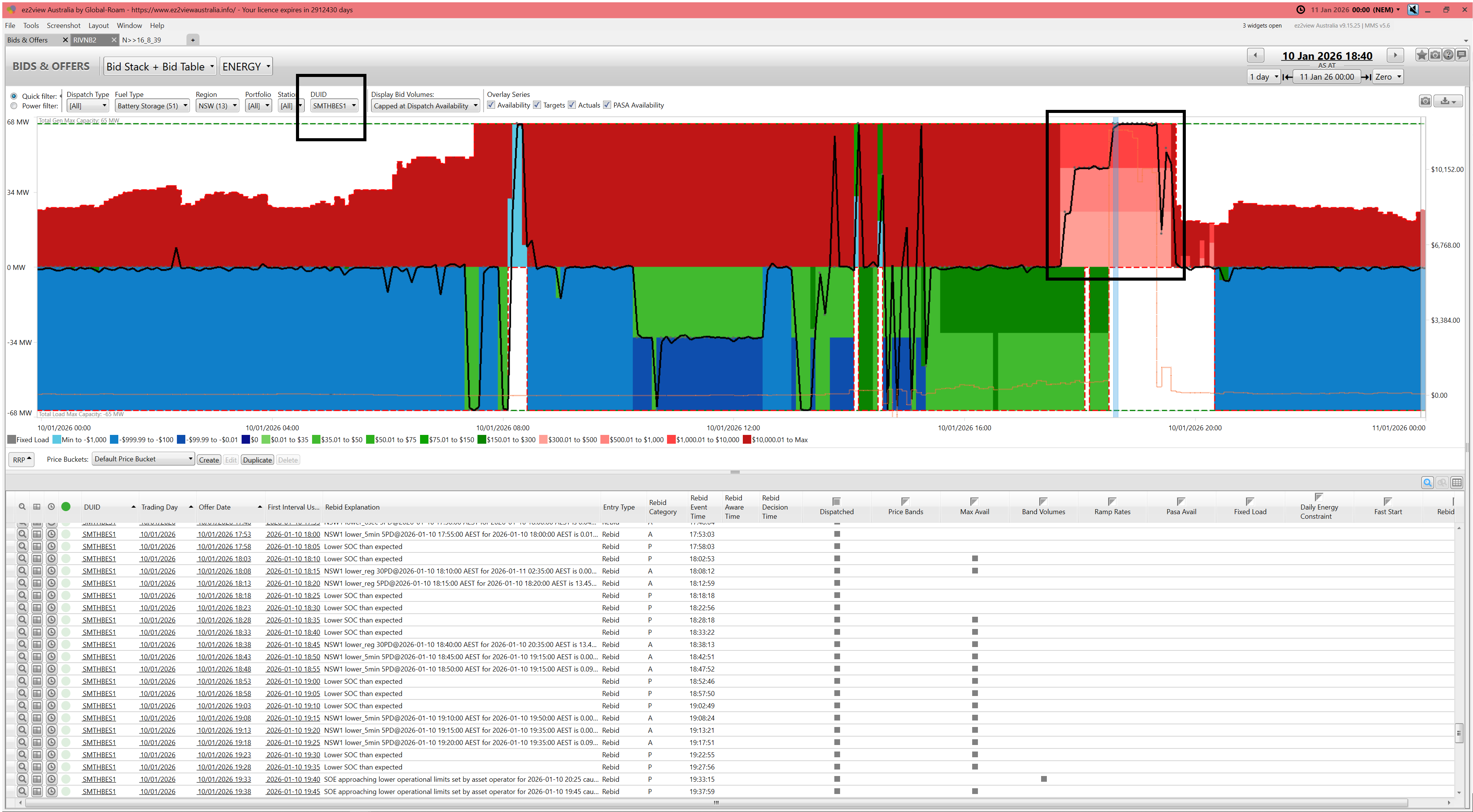
In this case:
1) The battery:
(a) had a longer run of discharge than most of the other batteries above
(b) with the output profile determined by:
i. the bid position change from the 17:45 dispatch interval
ii. dropping volume from $19,036.44/MWh at the RRN to three lower bid bands ($9,240.44/MWh and $12,78.88/MWh and $588.88/MWh and $388.88/MWh)
iii. which means ramping to almost full discharge at the 18:35 spike.
2) Also worth noting that this unit:
(a) was not affected by the ‘constraint of the day’
(b) nor was the constraint referenced in rebidding
(c) but it was subject to a bound ‘C_N_SMTHBES1_065_G’ constraint equation:
i. which limits output to 65MW
ii. which happens to be (ironically?) the Maximum Capacity of the unit?!
… another rabbit hole I’ll steer away from.
WALGRV1 (Wallgrove Battery)
Second last on the list is the Wallgrove Battery unit:
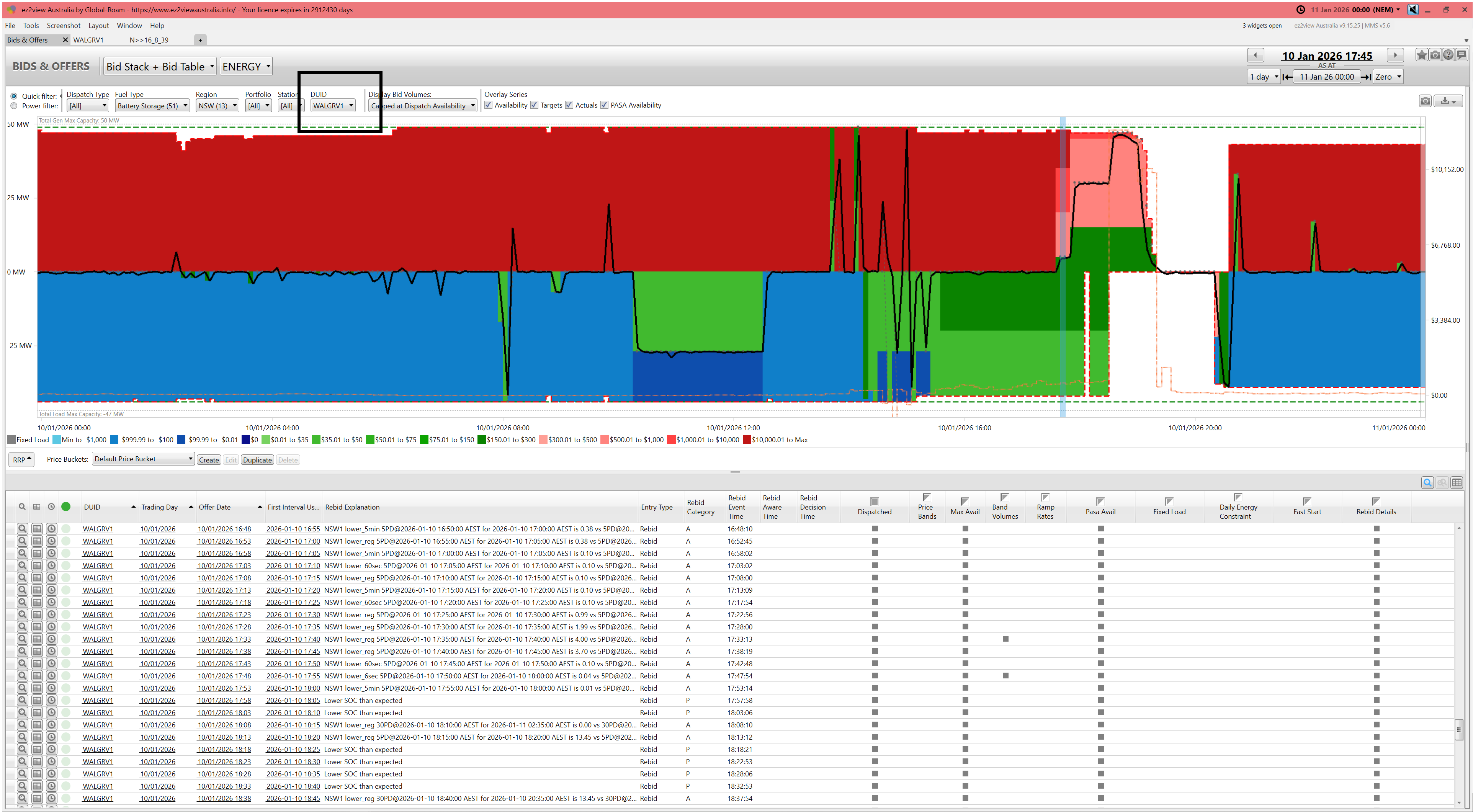
There’s some similarities with some other batteries above:
1) Which are not affected by the ‘constraint of the day’
2) So whose output is determined more directly by simpler bid stacking
3) With an output profile shaped by volume spread over a few bid bands
WTAHB1 (Waratah Battery)
Last, but not least, was the Waratah Battery unit:
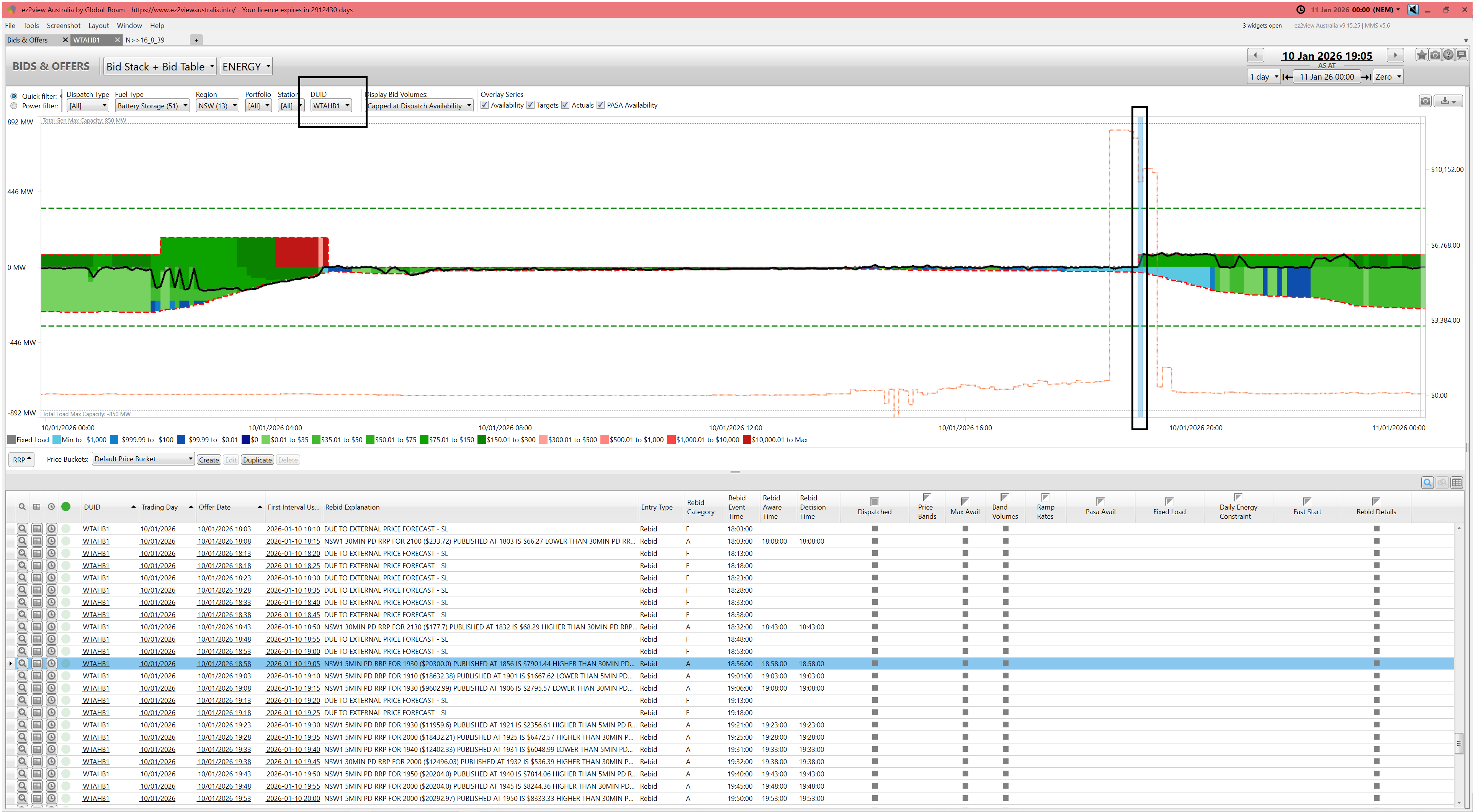
Now this unit
1) was the focus of this other article on Wednesday morning,
2) but in this article we’re looking back to Saturday evening, and we have other questions:
(a) why the delay in offering capacity to discharge (i.e. only at 19:05, and not in response to earlier spikes)?
i. Was this related to SIPS?
ii. Or for some other reason?
(b) and, even at 19:05, why only 75MW offered?
3) But, again, no time for that rabbit hole…
Aggregate State of Charge
In the copies of the ‘Bid Table’ above, we can see many examples of ‘State of Charge’ (or SOC) used as the reason for the rebid. Useful to present this trend of aggregate operation (and State of Charge) across the day as some context:
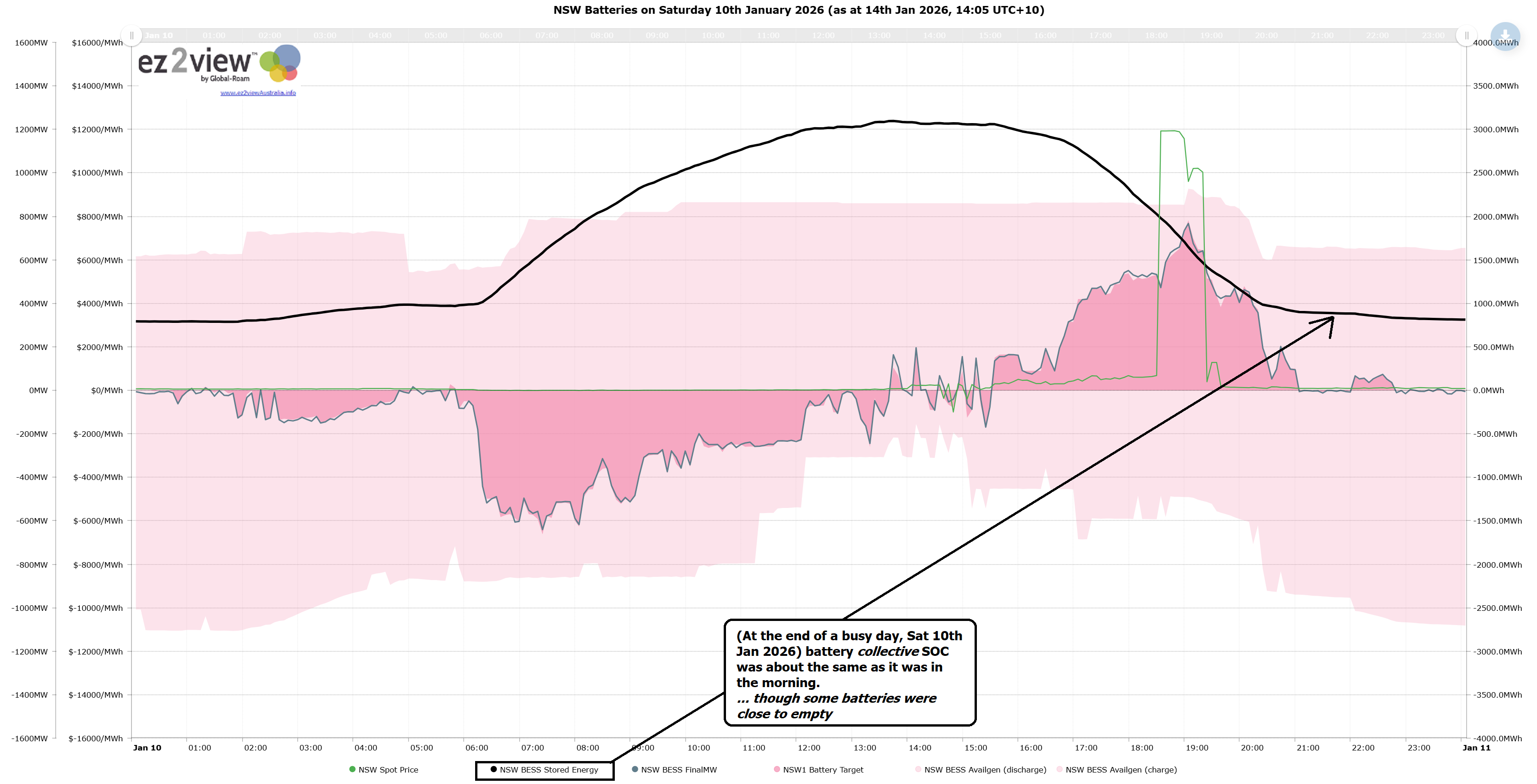
As noted:
1) the level of stored energy at the end of the day was roughly the same as what it was at the beginning (in aggregate across all units)
2) noting that some batteries were closer to empty, in relative terms.
What about other (non-battery) units?
These units will need to wait for their own article…

Be the first to comment on "Looking further into battery operations during NSW volatility on Saturday 10th January 2026"