

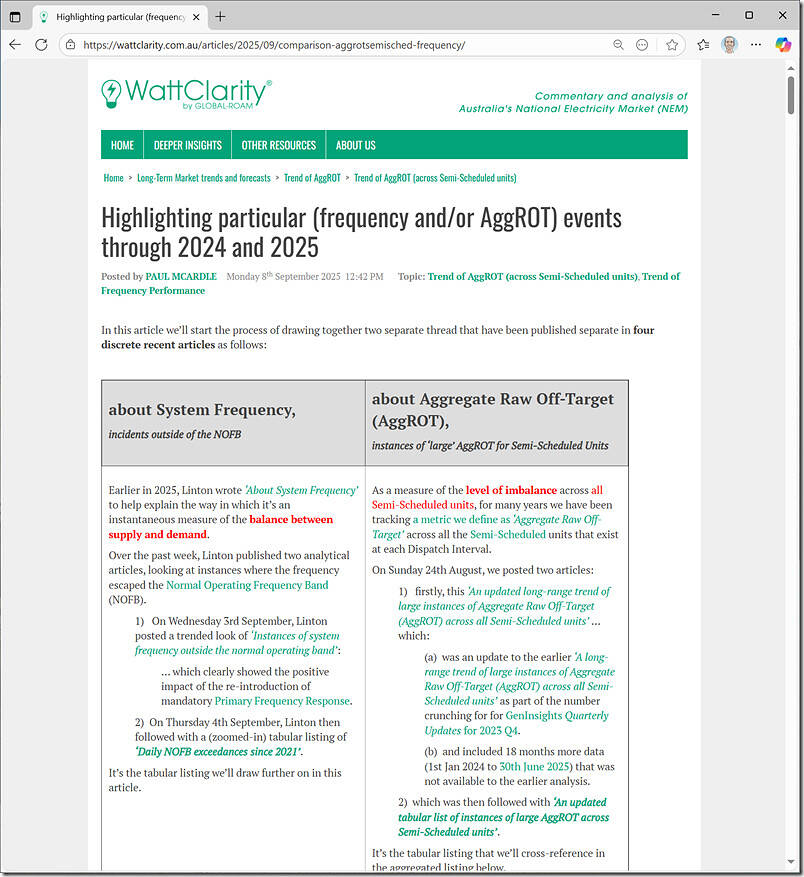
Over two months ago (on 8th September 2025), we posted this article ‘Highlighting particular (frequency and/or AggROT) events through 2024 and 2025’.
… that table:
(a) was complete to 30th June 2025 (i.e. at the end of Q2),
(b) was built from the earlier ‘An updated tabular list of instances of large AggROT across Semi-Scheduled units’ published on 24th August.
(c) focused on instances of Aggregate Raw Off-Target (AggROT) larger than 600MW (for Semi-Scheduled units).
Since that time:
1) I spoke on Wednesday 8th October 2025 at the NEMdev 2025 conference, including to highlight some concerns
(a) during which I flagged a number of concerns;
(b) including with a focus on the incidence of AggROT larger than 300MW
2) Especially given that Tim and Phil could not stay at the conference until my graveyard shift, I’ve been progressively sharing some considerations with respect to the draft report of the Nelson Review – and, in particular with respect to this article:
(b) followed by (with respect to ‘Concern #2’) this comparison of ‘… AggROT for (44x) Coal Units with AggROT for Semi-Scheduled units through the history of the NEM’.
… in which case we used an AggROT threshold of 500MW for classifying ‘large’
So note the three different thresholds used for ‘large’ (i.e. 600MW, 300MW and 500MW), and how the subjectivity of the decision.
A couple weeks ago at All Energy 2025 a number of people pulled me up for a chat about some realizations they made in the light of these trended statistics.
… this prompted me to think that the 6-quarter view in this table from 8th September could probably benefit from an update.
In the 3 weeks since All Energy 2025 we’ve noted that:
1) We’re fast approaching the release of the Final Recommendations of the Nelson Review panel.
2) And we’ve also noted other discussions continuing outside of the Nelson Review panel, as well.
I’m away next week, so wanted to publish this update before the end of November, to be there for readers who want to explore more.
Partially through 2025 Q4
We’re only part-way through the current quarter (2025 Q4):
- so obviously we’ll need to loop back around sometime in early 2026 in order to collate a fuller list;
- and also note that we’ve not yet done the number crunching with respect to Aggregate Raw Off-Target for Semi-Scheduled units:
- We only do that at the end of each quarter
- But, in the meantime, we can use Dispatch Error
- which is a lead-in to calculating Aggregate Raw Off-Target
- with the difference just being allowance for enablement for Regulation FCAS in the relevant direction
- … which, aggregated across Semi-Scheduled units, is not material.
With these caveats in mind, here’s a listing of some of the events in 2025 Q4 seeing either frequency excursions and/or large Dispatch Errors for semi-scheduled units.
Readers should be aware that the longer list of rows in the table (i.e. Frequency Events) compared to how the AEMO might typically report corresponds to a different criteria for identifying ‘Frequency Events’ – whereby:
1) Any event where readings (from AEMO 4-second data and/or our 0.1 second data) were outside the NOFB for even an instant in time are recorded below:
(a) in red colour if low;
(b) or in blue colour if high;
2) Any event where readings (from AEMO 4-second data and/or our 0.1 second data) were ‘close*’ to the NOFB for even an instant in time are recorded below in orange colour (or light blue);
* noting that
(a) we interpret ‘close’ here as within 0.05Hz … so above 50.1Hz, or below 49.9Hz
(b) with the logic being that PFR and Regulation FCAS should be keeping the frequency within 0.05Hz (say) of 50Hz
(c) … so anything more than twice as far away from 50Hz is notable.
| 2025 Q4
(in reverse chronological order) |
Overview of incident:
(a) frequency* outside of the NOFB * using both: |
Overview of incident:
(b) large AggROT* across all Semi-Scheduled units * using Dispatch Error as a proxy for 2025 Q4, but not comprehensively reviewing the list through the quarter. |
|---|---|---|
| Saturday 15th November 2025 |
A low point of 49.864Hz at 13:50:12.8 (still within the NOFB). |
We speculated (but have not yet explored) if this was due to to collective VRE underperformance. |
|
We wrote about these ‘Drops in mainland frequency on Saturday afternoon 15th November 2025’ … noting that the frequency did not drop outside the NOFB |
||
| Tuesday 11th November 2025 |
A frequency spike (to 50.152Hz at 09:10:34.7), outside the NOFB. |
This was not related to collective performance of VRE. |
| Just after the working day started on Tuesday 11th November 2025 it appears that AEMO again suffered from some data glitch (similar to Thursday 6th November), in which:
1) Created (the appearance of) a rapid ramp in ‘Market Demand’ in the Victorian region … but which was not there in reality 2) Ramping up units to meet this (phantom) increase in demand 3) Which overcooked the system frequency, driving it well beyond the NOFB. |
||
| Friday 7th November 2025 |
A low point of 49.865Hz at 13:55 (still within the NOFB). |
We speculated (but have not yet explored) if this was due to to collective VRE underperformance. |
|
We wrote about these ‘Mainland Frequency wanders south early Friday afternoon 7th November 2025’ … noting that we did not extract the frequency (at this point) to confirm that it was contained within the NOFB. |
||
| Thursday 6th November 2025 |
A frequency spike (to 50.233Hz at 12:45:21.2), outside the NOFB. |
This was not related to collective performance of VRE. |
| Around lunchtime on Thursday 6th November 2025 it appears that AEMO suffered from some data glitch, which:
1) Created (the appearance of) a rapid ramp in ‘Market Demand’ in the Victorian region … but which was not there in reality 2) Ramping up units to meet this (phantom) increase in demand 3) Which overcooked the system frequency, driving it well beyond the NOFB. |
||
| Monday 3rd November 2025 |
A low point of 49.899Hz at 08:04 (still within the NOFB). |
… that has not been investigated |
|
Nothing further, at this point. |
||
| Sunday 2nd November 2025 |
Two end-points to note: … both within the NOFB. |
… which have not been investigated |
|
Nothing further, at this point. |
||
| Saturday 1st November 2025 |
A low point of 49.895Hz at 21:23 … still within the NOFB. |
… unrelated to VRE. |
|
We noted this in ‘Loy Yang B1 returns to service after planned outage – not without a few wobbles (and frequency drop)’. |
||
| Friday 31st October 2025 |
Lowest point was at 49.841Hz at 13:55:28.1 (below the NOFB) |
This appears to have been due to collective under-performance of Solar Farms. |
|
We’ve already posted several articles about this event:
|
||
| Thursday 30th October 2025 |
A frequency drop:
… around 17:01 (NEM time) on Thursday 30th October 2025. |
This appears to have been due to collective under-performance of Solar Farms. |
|
We’ve already posted several articles about this event:
|
||
| Wednesday 29th October 2025 |
A low point of 49.898Hz at 14:20 … still within the NOFB. |
… which has not been investigated |
|
Nothing further, at this point. |
||
| Tuesday 28th October 2025 |
A low point of 49.891Hz at 20:57 … still within the NOFB. |
This was not related to VRE. |
|
The morning after, we’d written about the ‘Frequency drop with trip of Callide B2 on Tuesday evening 28th October 2025’. |
||
| Monday 27th October 2025 |
Two end-points to note: … both within the NOFB. |
… neither of which have been investigated. |
|
Nothing further, at this point. |
||
| Sunday 26th October 2025 |
A low point of 49.9Hz at 18:33 … still within the NOFB. |
This was not related to VRE. |
|
The morning after, we’d written about the ‘Sharp mainland frequency drop, with trip of CPP_4 on Sunday evening 26th October 2025’. |
||
| Thursday 23rd October 2025 |
A low point of 49.893Hz at 15:37 … still within the NOFB. |
… that has not been investigated. |
|
Nothing further, at this point. |
||
| Tuesday 21st October 2025 |
A low point of 49.874Hz at 17:32 … still within the NOFB. |
… that has not been investigated. |
|
Nothing further, at this point. |
||
| Sunday 19th October 2025 |
A low point of 49.898Hz at 15:26 … still within the NOFB. |
… that has not been investigated. |
|
Nothing further, at this point. |
||
| Friday 17th October 2025 |
A low point of 49.898Hz at 10:04 … still within the NOFB. |
… that has not been investigated. |
|
Nothing further, at this point. |
||
| Thursday 16th October 2025 |
Three different frequency drops, as noted below. Lowest was to 49.826Hz at 16:49 (i.e. Event #3 … outside the NOFB). |
Of these three events, #2 and #3 appear due to VRE underperformance. |
|
Noting that there were several different frequency events on this day, we’ve already written articles including:
These events will be explored further, time permitting. |
||
| Wednesday 15th October 2025 |
A low point of 49.897Hz at 09:54 … still within the NOFB. |
… that has not been investigated. |
|
Nothing further, at this point. |
||
| Tuesday 14th October 2025 |
The lowest frequency on this day was (only) to 49.908Hz at 15:22 … |
… and this has not been investigated. |
|
Separately, we wrote ‘Small spike in Mainland Frequency, with (apparent) ~400MW trip of demand in Queensland on Tuesday morning 14th October 2025’. |
||
| Sunday 12th October 2025 |
A high point of 50.11Hz at 09:49 … still within the NOFB. |
… that, whilst related to VRE, was not major. |
|
Amongst the articles we wrote was ‘Aldoga Solar Farm on Sunday 12th October 2025 – Part 2’, following the long period of Non-Conformance there. |
||
| Sunday 5th October 2025 |
A low point of 49.888Hz at 17:02 … still within the NOFB. |
… which has not been investigated. |
|
Nothing further, at this point. |
||
| Thursday 2nd October 2025 |
A low point of 49.886Hz at 16:25 … still within the NOFB. |
… that we suspect was related to under-performance of VRE. |
|
We noted briefly about ‘NEM Mainland Frequency wanders south as the sun sets, on Thursday 2nd October 2025’, |
||
Comprehensive, for 2025 Q3
In contrast to the (incomplete) 2025 Q4 above, we can now list more conclusively the performance stats through 2025 Q3 in the following table.
Relevant to this article, we noted earlier the recently released AEMO report ‘Frequency Monitoring – Quarter 3 2025’. Within this report:
1) The AEMO noted (p8/35) that:
‘AEMO has noted multiple Dispatch Intervals during which the NEM frequency drifted to limits of the normal operating frequency band (NOFB) without any contingency events. As a result, AEMO is actively reviewing the performance of various plants during these instances and collaborating with proponents to address the underlying cause of the issue. Consequently, a few plants have identified and reported non-compliances and are working to resolve the matter. In contrast, others are still under investigation. In the meantime, AEMO has been assessing the regulation FCAS volumes, particularly concentrating on cases where regulation FCAS reserves have been exhausted to uphold frequency within the NOFB. AEMO will evaluate a strategy for the dynamic distribution of regulation amounts if it is considered essential to sustain frequency performance in the NEM’
2) With respect to AEMO’s assessment of its performance against the Frequency Operating Standard, on p14/35 the AEMO notes:
(a) One incident on the mainland of not recovering within the normal operating frequency band (NOFB) within 5 minutes
… which just happened to be the 19th August 2025, as noted here.
(b) Compared to 12 incidents in Tasmania
… which are not the focus of this tabulation here.
Again, readers should be aware that the longer list of rows in the table (i.e. Frequency Events) compared to the 1 Event listed in the AEMO quarterly report above corresponds to a different criteria used here (as explained for 2025 Q4 above).
| 2025 Q3
(in reverse chronological order) |
Overview of incident:
(a) frequency* outside of the NOFB * using both: |
Overview of incident:
(b) large AggROT* across all Semi-Scheduled units * calculated from Dispatch Interval data: |
|---|---|---|
| Tuesday 30th September 2025 |
A low point of 49.898Hz at 16:21 (whilst still within the NOFB) …. |
… lines up with the AggROT (SemiSched) = +754MW at the 16:20 dispatch interval (NEM time). So this does suggest some contribution of collective underperformance of Semi-Scheduled units. Note also that:
|
|
There’s not yet been any focused article written about this event. |
||
| Monday 29th September 2025 |
Lowest point on the day of 49.926Hz at 15:26:28 (whilst still within the NOFB) …. |
… lines up with AggROT = +545MW at 15:30. So this does suggest some contribution of collective underperformance of Semi-Scheduled units. |
|
There’s not yet been any focused article written about this event. |
||
| Sunday 28th September 2025 |
Lowest point on the day of 49.932Hz at 14:44:28 (whilst still within the NOFB) …. |
… lines up with AggROT = +564MW at 14:45. So this does suggest some contribution of collective underperformance of Semi-Scheduled units. |
|
There’s not yet been any focused article written about this event. |
||
| Friday 26th September 2025 |
A low point of 49.904Hz at 16:35:30 (whilst still within the NOFB) …. |
… loosely corresponds with underperformance of VRE through the afternoon:
So this does suggest some contribution of collective underperformance of Semi-Scheduled units (but perhaps other factors as well). |
|
There’s not yet been any focused article written about this event. |
||
| Saturday 20th September 2025 |
A low point of 49.876Hz at 16:55:32 (whilst still within the NOFB) …. |
… lines up with AggROT = +599MW at 16:55. So this does suggest some contribution of collective underperformance of Semi-Scheduled units (but perhaps other factors as well). |
|
We’d written ‘A brief recap of a large afternoon frequency wobble on the NEM mainland on Saturday 20th September 2025’ on the following day. … in that article, highlighting the collective underperformance of Semi-Scheduled units. |
||
| Sunday 14th September 2025 |
A high point of 50.103Hz at 10:20 (whilst still within the NOFB) …. |
… at 10:20, the AggROT = -224MW (over-performance):
|
|
No frequency data investigated for this dispatch interval… |
Later in the day (at 14:30) the AggROT = –616MW (i.e. a relatively rare instance of large collective over-performance). |
|
|
There’s not yet been any focused article written about either event. |
||
| Thursday 11th September 2025 |
A low point of 49.883Hz at 17:52:34 (whilst still within the NOFB) …. |
Note that AggROT = +22MW at 17:55
|
|
We’d written, the next day, about the ‘Frequency drop on Thursday evening 11th Sept 2025 with Tallawarra B trip’ that helps to explain. |
||
| Wednesday 10th September 2025 |
A low point of 49.875Hz at 16:45:32 (whilst still within the NOFB) …. |
Note that AggROT = +116MW at 17:55. … so it would appear this low point in frequency was not primarily related to underperformance of Semi-Scheduled units. |
|
There’s not yet been any focused article written about this event. |
||
| Tuesday 2nd September 2025 |
A low point of 49.896Hz at 16:25:36 (whilst still within the NOFB) …. |
Note that through a period of 9 x Dispatch Intervals, we saw noteworthy (but not extreme) under-performance:
… so, whilst collective underperformance of Semi-Scheduled units does seem to have played some role, the timing of the lowest point also suggests other factors:
|
|
There’s not yet been any focused article written about this event. |
||
| Saturday 30th August 2025 |
A low point of 49.874Hz at 19:22:35 (whilst still within the NOFB) …. |
Note that AggROT = -5MW at 19:25. … so it would appear this low point in frequency was unrelated to underperformance of Semi-Scheduled units. |
|
We’d noted ‘Mainland frequency drop with Loy Yang A1 trip on Saturday evening 30th August 2025’ at the time. |
||
| Friday 29th August 2025 |
Lowest point (in the AEMO 4-second data) was to 49.847Hz at 11:50:35 (i.e. outside the NOFB). |
Note that:
… so it would appear this low point in frequency was unrelated to underperformance of Semi-Scheduled units. |
|
There have already been several articles written about this day … including:
|
||
| Thursday 28th August 2025 |
A low point of 49.892Hz at 16:51:23 (whilst still within the NOFB) …. |
Note that:
So this does suggest some contribution of collective underperformance of Semi-Scheduled units (but perhaps other factors as well). |
|
There’s not yet been any focused article written about this event. |
||
| Wednesday 27th August 2025 |
A low point of 49.879Hz at 16:35:27 (whilst still within the NOFB) …. |
… which lines up with AggROT = +712MW at the 16:35 dispatch interval (NEM time). So this event appears to be one with collective under-performance of Semi-Scheduled units as a dominant driver. |
|
Whilst there were a number of articles written about various events on this day, there’s not yet been any focused article written about this event. |
||
| Tuesday 26th August 2025 |
There was a high point of 50.106Hz at 10:34:55 (whilst still within the NOFB) …. |
Note that AggROT = +224MW at 10:35.
|
|
There’s not yet been any focused article written about this event in the morning. |
||
|
However, more attention might be focused on the low point in the afternoon:
… so outside of the NOFB. |
Note that:
… so collective under-performance, but not very large. |
|
|
We examined this low point in the article ‘Frequency change with Yallourn unit 2 trip’ (which occurred to drive the low point) on the following day. |
||
| Monday 25th August 2025 |
A high point of 50.1Hz at 10:45:39 (whilst still within the NOFB) …. |
Note that
… so both dispatch intervals saw under-performance, so the higher frequency must have been due to other factors. |
|
A low point of 49.9Hz at 16:17:43 (whilst still within the NOFB) …. |
Note that AggROT = +243MW at 16:20. … so it would appear this low point in frequency:
|
|
|
There’s not yet been any focused article written about either of these events. |
||
| Tuesday 19th August 2025 |
Highest point (in the AEMO 4-second data) was to 50.207Hz at 12:06:04 (i.e. outside the NOFB). |
There were 5 sequential dispatch intervals with over-performance larger than 600MW: |
|
There is already a collation of articles here relating to the frequency spike through the ~25 minute period in the early afternoon. Amongst the collated articles, we noted that the ‘AEMO frequency monitoring report provides some details of frequency event (due to self-forecast glitch) on 19th August 2025’. |
||
| Friday 15th August 2025 |
A low point of 49.898Hz at 15:47:40 (whilst still within the NOFB) …. |
Note that:
… so it would appear this low point in frequency:
|
|
There’s not yet been any article written about this event. |
||
| Wednesday 6th August 2025 |
A low point of 49.896Hz at 02:00:59 (whilst still within the NOFB) …. |
Note that:
So clearly this event
|
|
There’s not yet been any article written about this event. |
||
| Tuesday 5th August 2025 |
A low point of 49.886Hz at 16:32:32 (whilst still within the NOFB) …. |
… which lines up with AggROT = +534MW at 16:35. So it would appear this low point in frequency:
|
|
There’s not yet been any article written about this event. |
||
For the 2025 Q2, 2025 Q1 and the 4 quarters in 2024
Rather than repeating prior materials, I’d direct you to the table that’s the focus of the earlier article ‘Highlighting particular (frequency and/or AggROT) events through 2024 and 2025’:

Be the first to comment on "Extending the tabulated history of significant (Frequency and/or AggROT) events into 2025 Q3 and 2025 Q4"