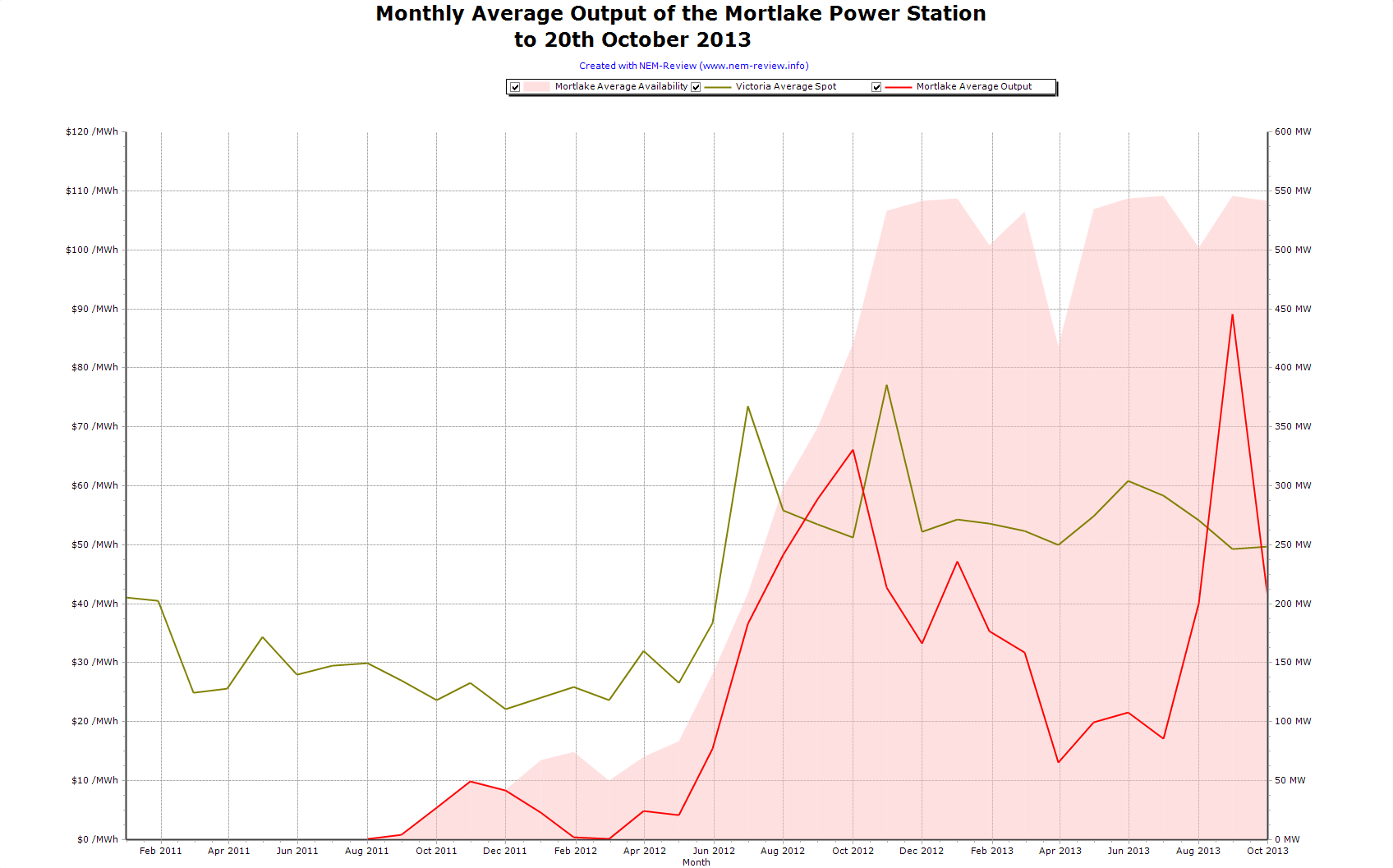
One of our regular WattClarity readers pointed out the significantly increased production volumes at Mortlake seen through the month of September – as shown here in this trend from NEM-Review:
It’s possible that the increase in September was a result of seasonal/portfolio factors (we note that there was a similar increase in spring 2012 before production subsided through summer – which asks the question of whether this is because of maintenance outages on other units in the Origin Energy portfolio).
Paul was one of the founders of Global-Roam in February 2000. He is currently the CEO of the company and the principal author of WattClarity. Writing for WattClarity has become a natural extension of his work in understanding the electricity market, enabling him to lead the team in developing better software for clients.
Before co-founding the company, Paul worked as a Mechanical Engineer for the Queensland Electricity Commission in the early 1990s. He also gained international experience in Japan, the United States, Canada, the UK, and Argentina as part of his ES Cornwall Memorial Scholarship.
The surge in NEM spot prices since 2015, and related impacts on contract and retail prices, have been extensively discussed and analysed in many forums, from ACCC inquiries to Twitter. The underlying reasons for the rise are well understood and…
Two large thermal generating units in Victoria with combined capacity of over 800 MW have recently experienced major electrical faults each requiring many months to repair. Previous WattClarity posts have covered initial assessments of the outages of AGL’s 530 MW Loy…
Mortlake probably has the cheapest gas of any gas-fired power station on the NEM. Its owner Origin owns the gas pipeline from the Port Campbell gas plant, so it doesn’t need to pay third-party pipeline owners. While it doesn’t own the Iona gas plant at Port Campbell, it does have a majority share in two offshore gas wells. So it’s strongly vertically integrated, and thus not subject to different financial pressures to other operators. Compare that with Tamar Valley, which requires the use of a premium 3-rd party asset to transport gas under Bass Strait, then another premium third-party asset to convey the power back to the mainland. Furthermore, the spot price of gas in Victoria is usually lower than in Adelaide or Brisbane. So Origin have done their sums well in choosing the location.
In recent weeks, Mortlake has been producing power right through the night, which is unusual for a single cycle gas turbine station. Several NSW generation units at Liddell and Eraring have been out of action, and at night net power import into NSW has been over 1000 MW. So is the cost of coal + carbon tax off-lining some coal-fired generation ?
Thanks for your clear and precise comments – perhaps there’s a role for you in posting on WattClarity 🙂
The shoulder seasons are normally maintenance periods – but with the overhang of surplus capacity, the incentive to work around the clock to bring units back is not what it once was.



Mortlake probably has the cheapest gas of any gas-fired power station on the NEM. Its owner Origin owns the gas pipeline from the Port Campbell gas plant, so it doesn’t need to pay third-party pipeline owners. While it doesn’t own the Iona gas plant at Port Campbell, it does have a majority share in two offshore gas wells. So it’s strongly vertically integrated, and thus not subject to different financial pressures to other operators. Compare that with Tamar Valley, which requires the use of a premium 3-rd party asset to transport gas under Bass Strait, then another premium third-party asset to convey the power back to the mainland. Furthermore, the spot price of gas in Victoria is usually lower than in Adelaide or Brisbane. So Origin have done their sums well in choosing the location.
In recent weeks, Mortlake has been producing power right through the night, which is unusual for a single cycle gas turbine station. Several NSW generation units at Liddell and Eraring have been out of action, and at night net power import into NSW has been over 1000 MW. So is the cost of coal + carbon tax off-lining some coal-fired generation ?
Hi Malcolm
Thanks for your clear and precise comments – perhaps there’s a role for you in posting on WattClarity 🙂
The shoulder seasons are normally maintenance periods – but with the overhang of surplus capacity, the incentive to work around the clock to bring units back is not what it once was.
Regards
Paul