

Noting the coincident trip of Callide C3 and C4 at ~16:55 (NEM time) on Thursday 15th January 2026, and especially noting that there’s some short-term reduction in availability at Callide B1 and B2, we wonder about what a common cause might be?
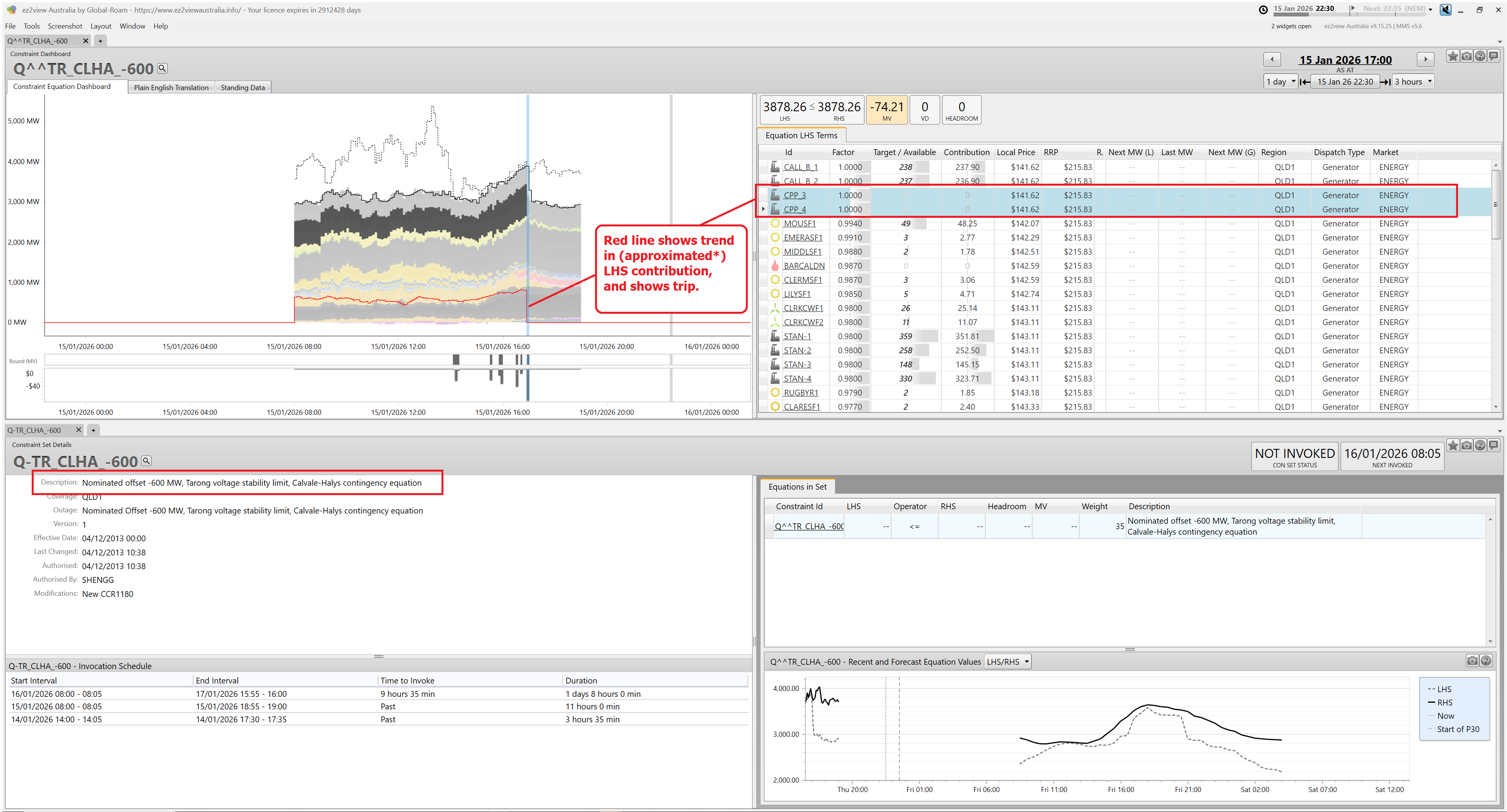
With readers cautioned that this is entirely speculation, I could not help notice the short-term invocation of the ’Q-TR_CLHA_-600’ constraint set today (and the single ‘Q^^TR_CLHA_-600’ constraint equation it contains), which:
1) Relates to ‘Nominated offset -600 MW, Tarong voltage stability limit, Calvale*-Halys contingency equation’;
* i.e. with Calvale being the Powerlink TNSP substation that Callide connects into!
2) With invocation today from 08:05 to 19:00 NEM time
3) And which had been having some small effect on limiting units on the LHS of the bound constraint equation (with Callide units at the top of the list with highest LHS factors)
Here’s a snapshot of the constraint set and constraint equation in ez2view at 22:30:
One we’ll be interested to understand more about in the coming days…

now described as an internal IT network overload caused by human error. Does that relate to the text above at all?