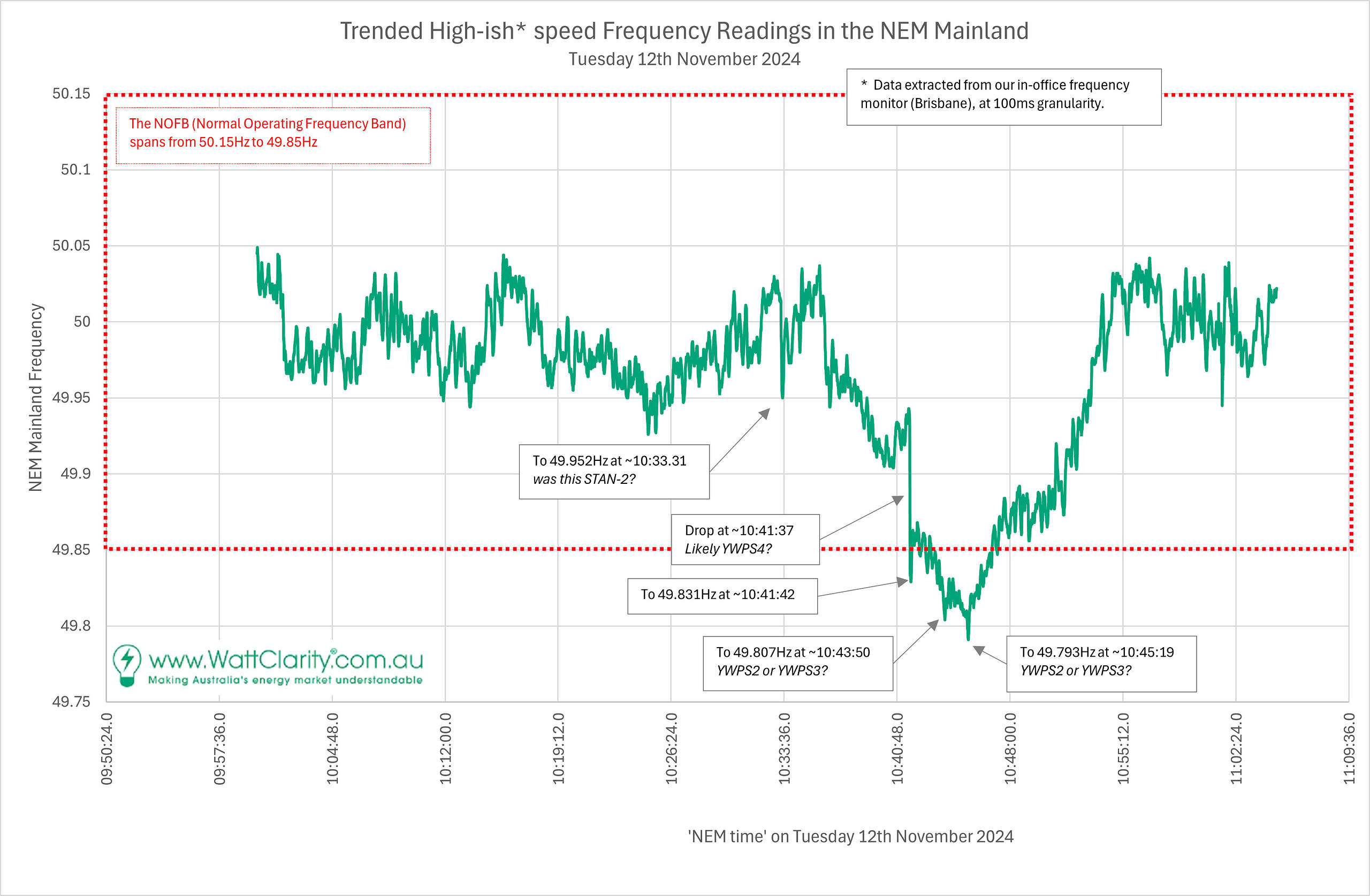
In the prior article we noted the tripping of four separate units (three at Yallourn – possibly due to some network issues). So we’ve guessed which-sat-where in the time-series frequency trace.
Paul was one of the founders of Global-Roam in February 2000. He is currently the CEO of the company and the principal author of WattClarity. Writing for WattClarity has become a natural extension of his work in understanding the electricity market, enabling him to lead the team in developing better software for clients.
Before co-founding the company, Paul worked as a Mechanical Engineer for the Queensland Electricity Commission in the early 1990s. He also gained international experience in Japan, the United States, Canada, the UK, and Argentina as part of his ES Cornwall Memorial Scholarship.
Partly prompted by a comment yesterday from a WattClarity reader (Liam), and powered by ‘next day public’ data, we take a look at Yallourn Power Station on Tuesday 12th November 2024.
This is the 2nd of 4 Case Studies to follow on from Tuesday’s main article (summarising results across 105,120 dispatch intervals through 2019 for ‘all Coal’ and ‘all Wind’ groupings). In this case, let’s look at the ‘worst’ case, in aggregate, where coal units over-performed compared to dispatch targets.
The (concerning) frequency spike across the NEM in the middle of the day (Tuesday 19th August 2025) has triggered many proximate questions – understandable – but also has raised these 3 Broader Questions.



Leave a comment