

Apologies to readers that this article will be a little cryptic, and incomplete. I just wanted to post this first article about the new ‘N^^N_NIL_WGLT’ constraint equation that first appeared in the dispatch process at the 10:20 dispatch interval leading on Monday 8th December 2025.
Brief background
It’s a system normal (i.e. always invoked) constraint equation with a stated purpose being:
‘limit Wagga to Lower Tumut (051) 330kV line flow to avoid voltage collapse post contingency trip of line 051, Feedback’
… so that means:
1) it’s yet another constraint equation that can have effects that Allan wrote about over 2 years ago in the article ‘What’s happening around Wagga?’
2) with the effect particularly pronounced if some of those 330kV lines in southern NSW are on outage.
It was was announced in MN131421 on Friday 5th December 2025 as follows:
‘——————————————————————-
MARKET NOTICE
——————————————————————-
From : AEMO
To : NEMITWEB1
Creation Date : 5/12/2025 18:39
——————————————————————-
Notice ID : 131421
Notice Type ID : New/Modified Constraints
Notice Type Description : MARKET
Issue Date : 5/12/2025
External Reference : New NSW system normal constraint to manage voltage collapse on loss of Lower Tumut to Wagga (051) 330kV line
——————————————————————-
Reason :
AEMO ELECTRICITY MARKET NOTICE
Transgrid has advised AEMO of an new voltage stability limit in south-west NSW for loss of Lower Tumut to Wagga (051) 330 kV line. AEMO has now completed the review and testing of this new constraint equation and will implement the following constraint equation in AEMOS Production systems at 0900hrs Monday 8th December 2025.
N::N_NIL_WGLT
This constraint equations includes the generators in southern NSW on the left-hand side as well as Murraylink and VNI.
For full details on the formulation, the new constraint equation has now been loaded into AEMO’s pre-production systems.
Ben Blake
AEMO Operations
——————————————————————-
END OF REPORT
——————————————————————-‘
Note, with respect to this market notice, that the constraint ID suggested here (i.e. N::N_NIL_WGLT) was subsequently changed to ‘N^^N_NIL_WGLT’ when it went live … and I have also seen it referred to as ‘N>>N_NIL_WGLT’.
Brief history
Quickly extracting the LHS, RHS and Marginal Value of the constraint since its arrival at 10:20 on Monday 8th December, we see the following:
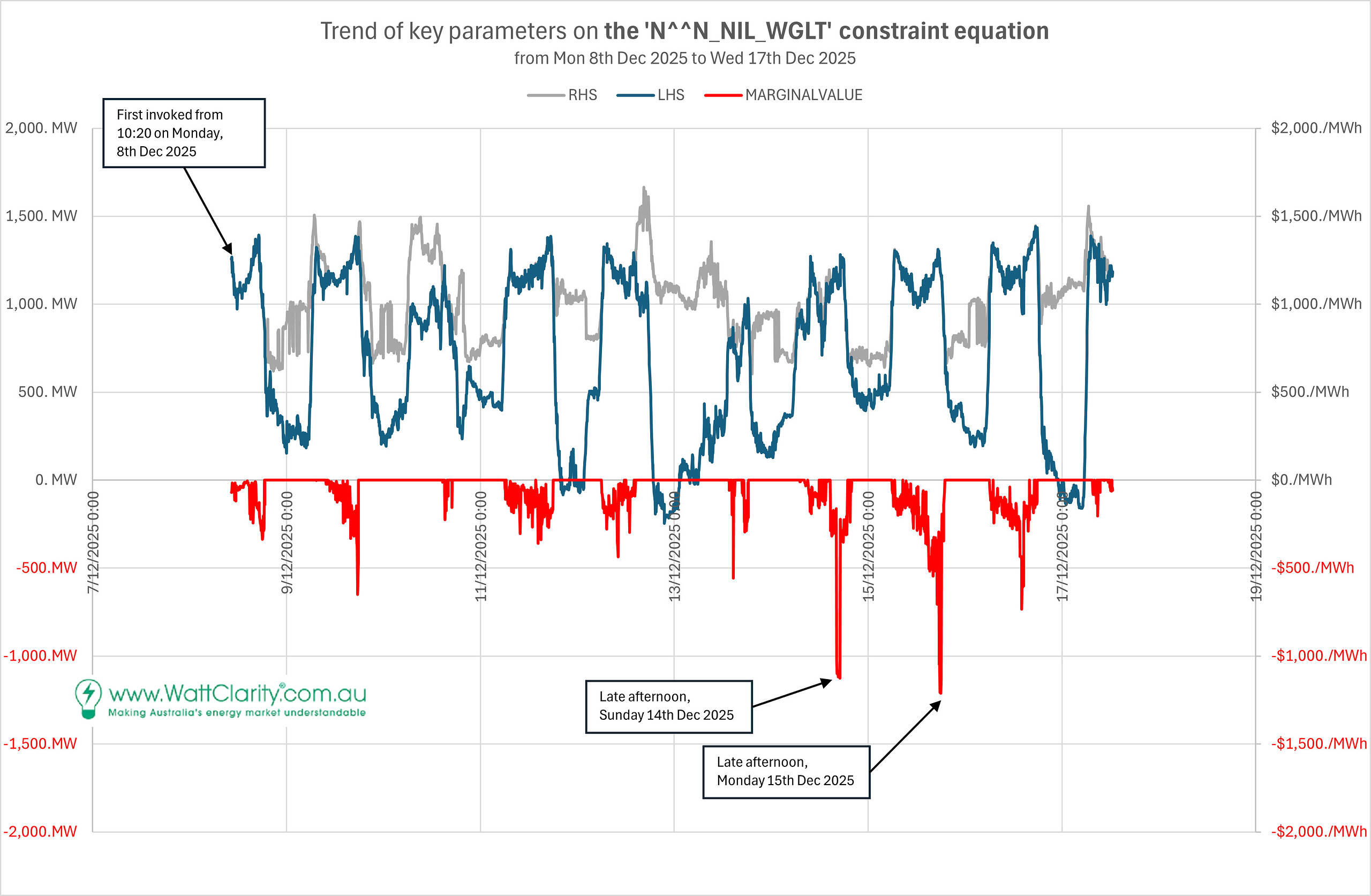
It’s bound for periods of every day since its emergence, with the largest Marginal Values being late afternoons on Sunday 14th December 2025, and Monday 15th December 2025.
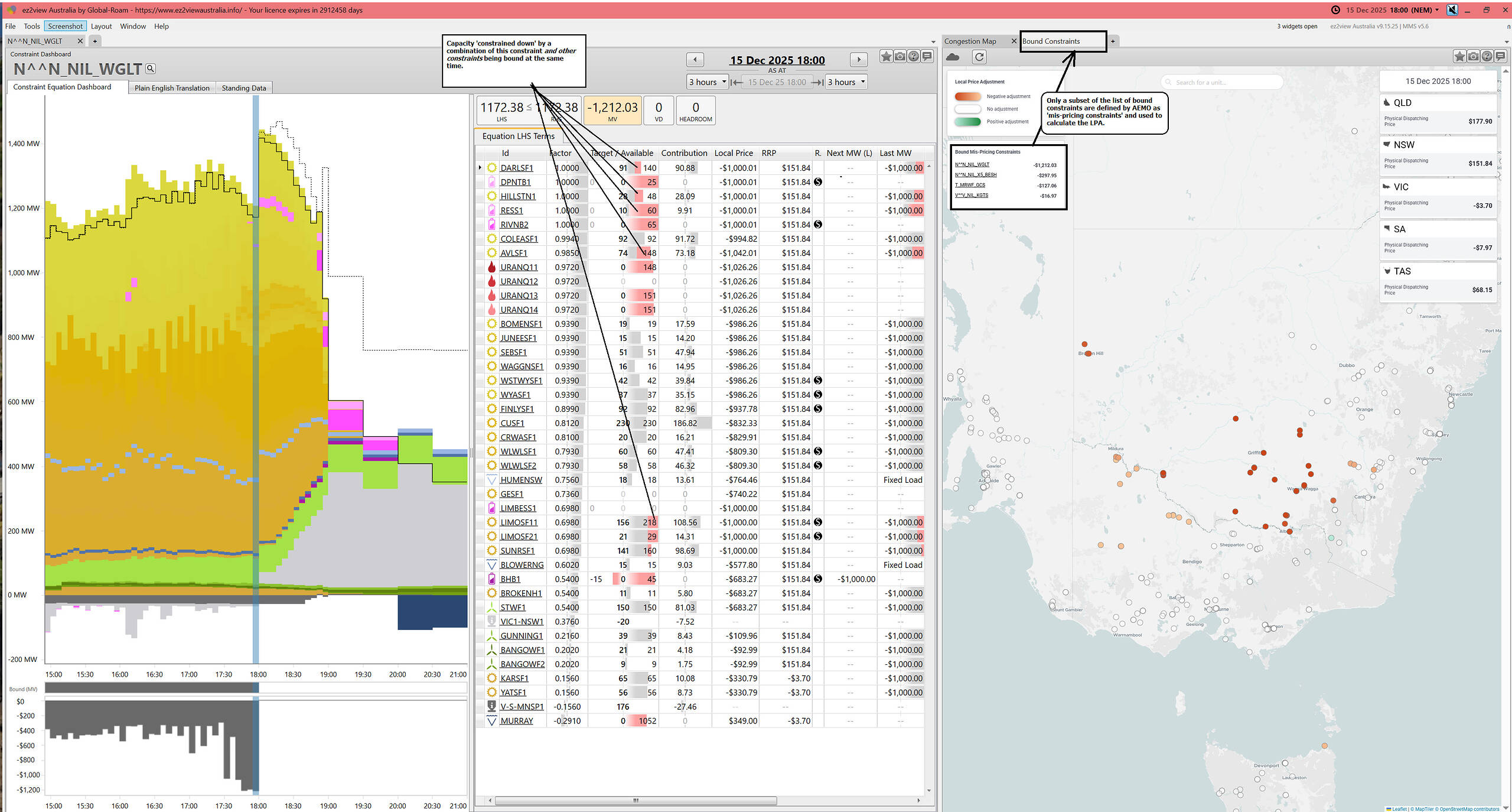
A spotlight on 18:00 on Monday 15th December 2025
Selecting the 18:00 dispatch interval on Monday 15th December 2025 (purely on the basis of the largest Marginal Value) we use time-travel in ez2view to look at some effects – with a combination of the ‘Constraint Dashboard’ widget and the ‘Congestion Map’ widget:
That’s all for now…

Be the first to comment on "A short first article, about the ‘N^^N_NIL_WGLT’ constraint equation"