

We’ve already posted about how ‘Mainland Frequency dragged downwards around sunset, on Sunday 30th November 2025’,
1) noting 4 discrete periods of frequency weakness (~17:20, ~17:35, ~17:50 and ~18:10 NEM time on Sunday 30th November 2025):
2) and (in the process) speculating that this might have been contributed to by some collective under-performance of Semi-Scheduled units over this period.
I’ve taken a few minutes today to use the ‘Trends Engine’ within ez2view to produce this trend of Aggregate Dispatch Error (NEM-wide) for each of the main fuel types in the NEM as follows:
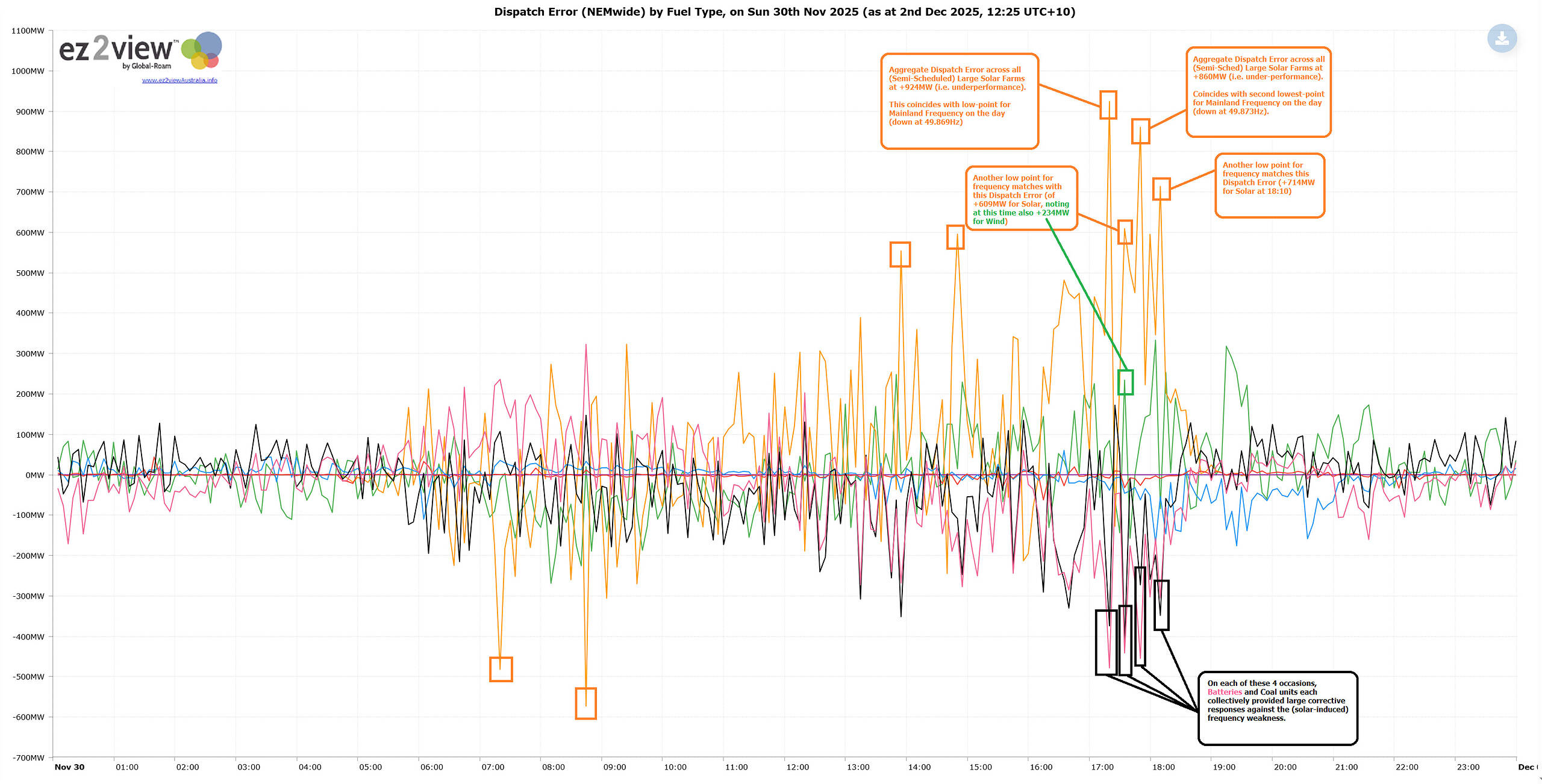
On this chart (showing all 288 dispatch intervals on the day):
1) I’ve highlighted the same 4 dispatch intervals (noted above with frequency weakness);
2) And frequent readers here won’t be surprised to learn that, as expected, these periods correlate with:
(a) collective under-performance of Semi-Scheduled units on each occasion
…. in these 4 cases mainly underperformance of Solar Farms.
(b) with the main measures for corrective response coming from Battery Units and Coal Units
… again, no surprises there.
3) Note also some other large deviations across the Large Solar Farms highlighted.
Clearly the current approach is not going to be sustainable, or scalable! But what to do…

Paul
Notwithstanding the solar forecast issues, isn’t the immediate problem that primary frequency response and regulation FCAS are not providing sufficient response to avoid these frequency sags, whatever their cause?
It seems arguable that AEMO ought to be enabling a lot more regulation volume, at least during solar ramp periods. This would have the physical benefit of keeping frequency closer to target – which after all is the key objective here – but also a market benefit in that it would raise the cost of regulation FCAS being incurred by the under-performers via frequency performance payments, so might prompt them to forecast better (or at least more conservatively)?
It could take a very long time to get any changes to the semi-scheduled generation category and rules. As far as I know AEMO could vary the volumes of FCAS enabled with very little lead time provided there is a reasonable justification for it. Which there certainly seems to be here.
Allan
Thanks Allan
My understanding is that the AEMO is exploring this as a possible first step … because (as you say) it would be a relatively simple/quick approach.
I’m wondering if doing that would be enough, as the Semi-Scheduled capacity continues to scale, and the mix of Scheduled capacity changes (perhaps with aggregate MW installed declining from current levels). Various people have looped me into different conversations where various options are being considered – at some point might have time to write about some of these.
Yep, sounds like a situation where multiple things might have be done, let’s do the quick obvious and easy to reverse ones first!